What Is Exhaust Drone? Causes & How to Reduce It
A louder exhaust can be intentional, but exhaust drone is different. Drone is a persistent low-frequency booming or humming sound that becomes noticeable inside the cabin, often at a specific engine speed or during steady highway cruising.
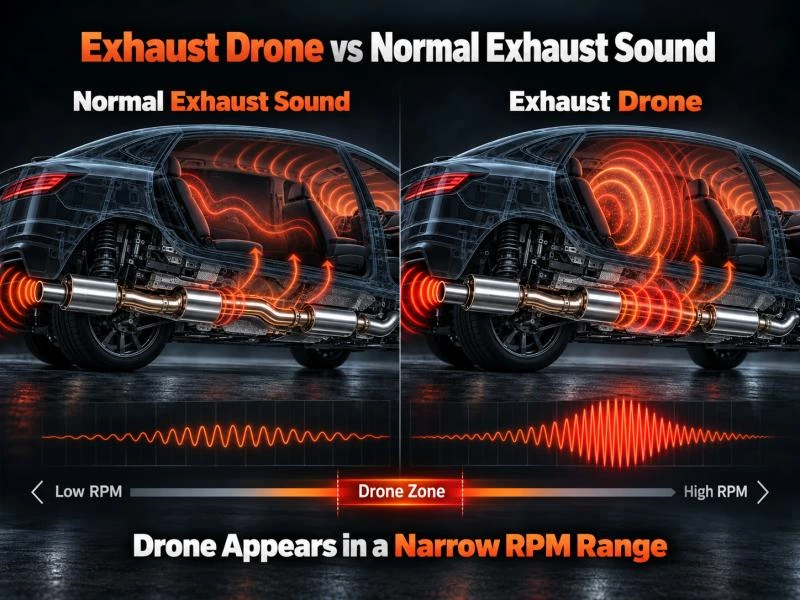
Unlike normal exhaust sound, which usually changes as the engine accelerates or decelerates, drone tends to appear within a relatively narrow RPM range. It may become uncomfortable during constant-speed driving and then fade quickly when engine speed moves above or below that range.
Exhaust drone is mainly a resonance problem rather than simply an overly loud exhaust. Pipe diameter and length, mufflers, resonators, exhaust routing, mounting points, engine operating speed, and the vehicle body can all influence how strongly certain frequencies are amplified.
Quick Answer: Exhaust drone is a low-frequency resonance that becomes especially noticeable at certain RPMs or cruising speeds. It is different from normal exhaust volume and usually needs to be addressed by identifying the frequency, exhaust design, or mounting condition causing the resonance.
What Is Exhaust Drone?
Exhaust drone is a sustained low-frequency sound or vibration that becomes especially noticeable inside the vehicle cabin. It is usually described as a deep booming, humming, or pressure-like noise that appears within a specific RPM range.
The key characteristic of exhaust drone is resonance. Sound waves generated by the engine and exhaust system can reinforce one another at certain frequencies. When those frequencies interact with the exhaust pipes, vehicle body, or cabin, the resulting sound can become much stronger than normal exhaust noise.
Drivers often notice exhaust drone during steady-speed cruising rather than hard acceleration. A vehicle may sound completely normal at lower and higher engine speeds but develop an uncomfortable boom when the engine remains within one particular RPM range.
What Does Exhaust Drone Sound Like?
Exhaust drone can vary between vehicles, but common descriptions include:
- A deep, continuous booming sound
- A low-frequency humming inside the cabin
- A pressure-like sensation that becomes tiring on long drives
- A vibration or sound that becomes stronger at a particular RPM
- A noise that decreases quickly when engine speed changes
In some cases, the exhaust may not sound excessively loud outside the vehicle. The problem becomes more noticeable inside because the cabin and body panels can amplify certain low-frequency sounds.
Exhaust Drone vs Loud Exhaust
Exhaust drone and a loud exhaust are not the same problem. A loud exhaust generally produces a higher sound level across a broad range of engine speeds, while drone is usually concentrated within a narrower frequency and RPM range.
| Characteristic | Exhaust Drone | Loud Exhaust |
|---|---|---|
| Sound | Low-frequency booming or humming | Higher overall exhaust volume |
| RPM Range | Usually occurs within a specific range | Can remain loud across a wider RPM range |
| Cabin Effect | Often especially noticeable inside the vehicle | Usually noticeable both inside and outside |
| Driving Condition | Common during steady cruising | Often becomes louder with acceleration |
This distinction is important because reducing overall exhaust volume does not always eliminate drone. The specific frequency causing the resonance must also be addressed.
Why Does Exhaust Drone Happen?
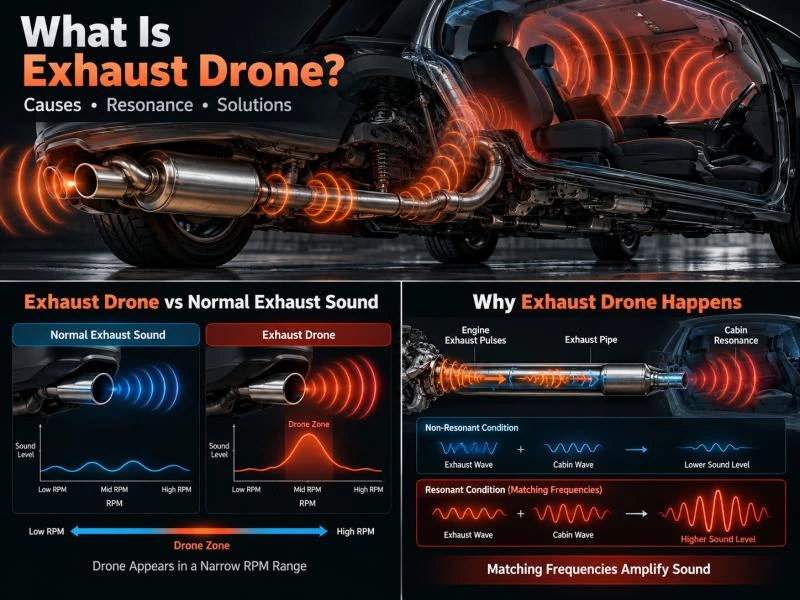
Exhaust drone is mainly caused by resonance. An internal-combustion engine does not produce a perfectly continuous exhaust flow. Each combustion event creates a pressure pulse that travels through the exhaust system as both gas flow and sound energy.
As engine speed changes, the frequency of these exhaust pulses also changes. At certain RPMs, the sound frequency produced by the engine can align with the natural resonant frequency of the exhaust system, vehicle body, or cabin. When this happens, the sound waves reinforce each other instead of cancelling out, creating the deep booming noise associated with exhaust drone.
Exhaust Pulses and Resonance
Every exhaust system has its own acoustic characteristics. Pipe length, diameter, bends, mufflers, resonators, outlet position, and vehicle layout all affect how sound waves travel through the system.
When the wavelength of an exhaust sound matches certain dimensions within the exhaust or vehicle structure, standing waves can form. These waves repeatedly reflect and reinforce the same frequency, making it much more noticeable inside the cabin.
This is why two vehicles with similar engines can experience different levels of exhaust drone. Even small differences in pipe geometry, muffler design, wheelbase, or cabin structure can change the frequency at which resonance occurs.
Why Does Drone Occur Only at Certain RPMs?
Exhaust drone does not occur at one fixed RPM for every vehicle. The problematic range depends on engine firing frequency, transmission gearing, exhaust dimensions, and vehicle construction.
A vehicle may therefore be quiet at lower engine speeds, develop a strong boom within a narrow RPM band, and then become quiet again as engine speed increases. Moving outside that range changes the exhaust pulse frequency and reduces the resonance.
For this reason, one of the most useful steps when diagnosing exhaust drone is to identify the exact engine speed and driving condition where the noise becomes strongest.
Key Point: Exhaust drone is not caused simply by having a loud exhaust. It occurs when exhaust-generated frequencies line up with a resonant frequency in the exhaust system or vehicle structure.
Why Does Exhaust Drone Get Worse at Highway Speed?
Exhaust drone is often most noticeable during highway cruising because the engine can remain at nearly the same RPM for a long period. If that engine speed falls within the exhaust system's resonant range, the low-frequency sound can continue instead of passing quickly as it would during acceleration.
During normal acceleration, engine speed moves through different frequency ranges relatively quickly. On the highway, however, the transmission may hold a high gear while the engine operates at a steady speed and load. This gives the resonant frequency more time to build and become noticeable inside the cabin.
Steady RPM Keeps the Vehicle in the Drone Range
A common example is a vehicle that feels comfortable around town but develops a deep booming sound during long-distance cruising. The exhaust may not have become louder overall; the engine is simply staying within the RPM range where resonance is strongest.
Changing speed, shifting gear, or increasing engine RPM slightly may reduce the noise because the exhaust pulse frequency moves away from the resonant range.
Why Cabin Resonance Matters
Highway drone is not determined by the exhaust pipe alone. Low-frequency sound can also interact with the vehicle floor, trunk area, body panels, and cabin volume. These structures may amplify certain frequencies and make the exhaust sound much stronger inside the vehicle than it does outside.
The effect can vary significantly between vehicle types. Differences in wheelbase, cabin size, exhaust length, underbody layout, and outlet position can all influence how much low-frequency sound reaches the occupants.
Factors that can make highway exhaust drone more noticeable include:
- Long periods of steady throttle and engine speed
- High transmission gears that keep RPM within the resonant range
- Exhaust pipe lengths and diameters that reinforce certain frequencies
- Reduced muffler or resonator control
- Large cabin or body cavities that amplify low-frequency sound
- Exhaust outlets or pipe sections positioned close to the vehicle body
This is why an exhaust system can sound aggressive but acceptable during acceleration while becoming tiring during constant-speed highway driving. The problem is not simply sound volume, but how long the vehicle remains at the frequency where resonance is strongest.
How to Reduce Exhaust Drone
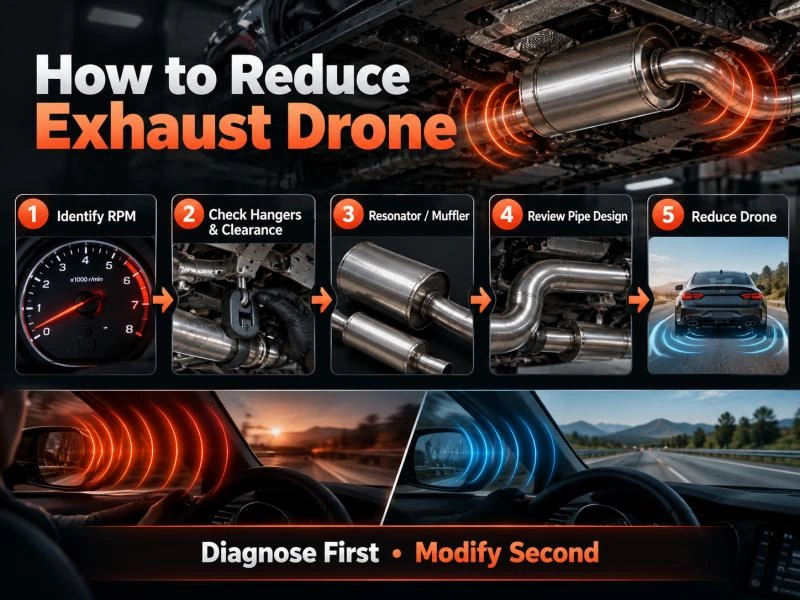
Reducing exhaust drone starts with identifying the condition that creates the resonance. Because drone is frequency-specific, replacing parts without first understanding when and why the noise occurs may change the exhaust sound without solving the actual problem.
1. Identify the RPM Range
Start by recording when the drone is strongest. Note the engine RPM, vehicle speed, transmission gear, and whether the noise occurs during acceleration or steady cruising.
If the booming sound consistently appears within a narrow RPM range and fades when engine speed moves above or below it, acoustic resonance is likely involved.
This information is useful when selecting a resonator, modifying pipe dimensions, or evaluating a custom exhaust system because the goal is to reduce the problematic frequency rather than simply lowering overall exhaust volume.
2. Check Exhaust Hangers and Pipe Clearance
Before modifying the acoustic components, inspect the exhaust system for mechanical vibration. Damaged rubber hangers, loose brackets, or insufficient clearance can transfer exhaust vibration directly into the vehicle body.
Check whether the exhaust pipe, muffler, or other components are touching:
- The chassis or crossmembers
- The vehicle floor
- Heat shields
- Suspension components
- Other exhaust components
Correcting a contact or mounting problem may significantly reduce cabin vibration without changing the exhaust design itself.
3. Add or Change a Resonator
A properly selected resonator is one of the most common ways to reduce exhaust drone. Resonators are designed to control specific sound frequencies and can help reduce the low-frequency boom that becomes noticeable during cruising.
However, resonator effectiveness depends on its size, internal design, location, and the frequency being targeted. Installing any resonator at any position does not guarantee that drone will disappear.
For a custom system, the resonator should be considered together with pipe length, diameter, muffler design, and the vehicle's normal cruising RPM.
4. Review the Muffler Design
If the existing muffler provides very little sound attenuation, changing the muffler may help reduce the overall acoustic energy reaching the cabin.
Different mufflers control frequencies differently, so the best choice depends on whether the goal is to reduce overall volume, low-frequency booming, or both.
A quieter exhaust note does not always mean the drone frequency has been fully addressed, which is why the muffler and resonator should be evaluated as parts of the complete system.
5. Review Pipe Diameter and Routing
Changing pipe diameter, overall length, bend geometry, or outlet position alters the acoustic behavior of the exhaust system.
For a newly designed exhaust, selecting an appropriate pipe diameter is preferable to correcting an oversized system after installation. A larger pipe is not automatically better for either flow or sound quality.
Routing should also maintain adequate clearance from the vehicle body while avoiding unnecessary changes that may create additional vibration or packaging problems.
6. Adjust Exhaust Length or Resonance Characteristics
For more complex custom systems, changing the effective pipe length or adding a tuned side branch can shift or cancel a problematic frequency.
These solutions require more precise design than simply adding a larger muffler because the dimensions must correspond to the frequency responsible for the drone.
Important: There is no single universal fix for exhaust drone. The correct solution depends on whether the problem comes from acoustic resonance, exhaust design, mounting, or physical contact with the vehicle body.
What Is a Helmholtz Resonator or J-Pipe?
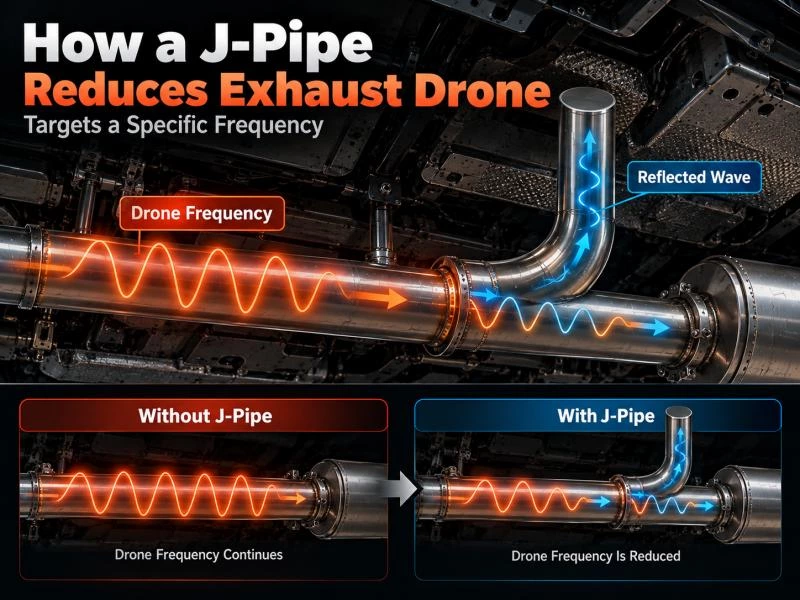
A Helmholtz resonator or J-pipe is a tuned acoustic device used to reduce a specific exhaust frequency rather than simply making the entire exhaust quieter.
In an exhaust application, a J-pipe typically consists of a closed-ended branch connected to the main exhaust pipe. Sound waves enter the branch, reflect from the closed end, and return toward the main exhaust flow.
When the branch is correctly tuned, the returning sound wave can oppose the problematic frequency and reduce its intensity. This principle makes J-pipes particularly useful when drone occurs within a narrow and predictable RPM range.
Why J-Pipe Length Matters
The effectiveness of a J-pipe depends heavily on its effective length and the target frequency. A branch designed for one frequency may have little effect on another.
This is why a J-pipe should not simply be copied from another vehicle. Differences in engine speed, exhaust temperature, pipe dimensions, and system layout can change the required tuning.
For many production exhaust systems, conventional resonators and mufflers provide a more practical solution. Tuned side branches are more useful when a specific narrow-band resonance needs additional control.
How to Avoid Exhaust Drone When Choosing an Exhaust System
Preventing drone during exhaust design is generally easier than correcting it after installation. For daily-driven vehicles in particular, sound during steady cruising should be considered alongside sound under acceleration.
When selecting or developing an exhaust system, consider the following factors:
- Vehicle-specific fitment: Exhaust design should match the vehicle's wheelbase, chassis, engine, and underbody layout.
- Correct pipe diameter: Pipe size should suit the engine and required flow rather than being selected only for maximum diameter.
- Resonator design: Retaining or properly designing a resonator can help control problematic frequencies.
- Muffler selection: The muffler should provide the desired exhaust character without allowing excessive low-frequency cabin noise.
- Pipe routing: Length, bends, and outlet position influence both fitment and acoustic behavior.
- Hanger locations: Proper mounting helps isolate exhaust vibration from the vehicle body.
- Cruising RPM: Daily-driving conditions should be considered during exhaust development, not only high-RPM operation.
This is especially important for custom and performance exhaust systems. Increasing sound level or reducing restriction should not come at the expense of excessive cabin resonance during normal driving.
Exhaust Drone in Trucks and SUVs
Trucks and SUVs can present additional exhaust design challenges because of their longer wheelbases, larger body cavities, different rear suspension layouts, and longer exhaust routing.
Pickup trucks may also require the exhaust pipe to pass around the rear axle, spare tire, fuel tank, suspension, and other chassis components before reaching the outlet.
These packaging differences influence pipe length, bend position, outlet location, and mounting points, all of which can affect resonance.
For this reason, an exhaust layout that works well on one wheelbase or engine configuration should not automatically be assumed to behave the same way on another version of the same vehicle.
OEM and Custom Exhaust Design for Noise Control
Exhaust system development involves more than maximizing gas flow. For OEM and custom applications, sound quality, cabin comfort, fitment, durability, and manufacturing consistency also need to be considered.
Important design information may include:
- Vehicle make, model, year, and engine
- Target pipe diameter and wall thickness
- Exhaust routing and available installation space
- Muffler and resonator configuration
- Flange and hanger positions
- Single or dual outlet requirements
- Target sound characteristics
- Typical cruising conditions
Vehicle-specific exhaust development can help balance flow, sound, clearance, and production requirements rather than treating each component separately.
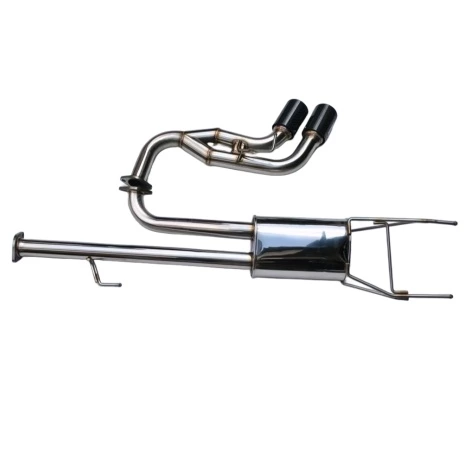
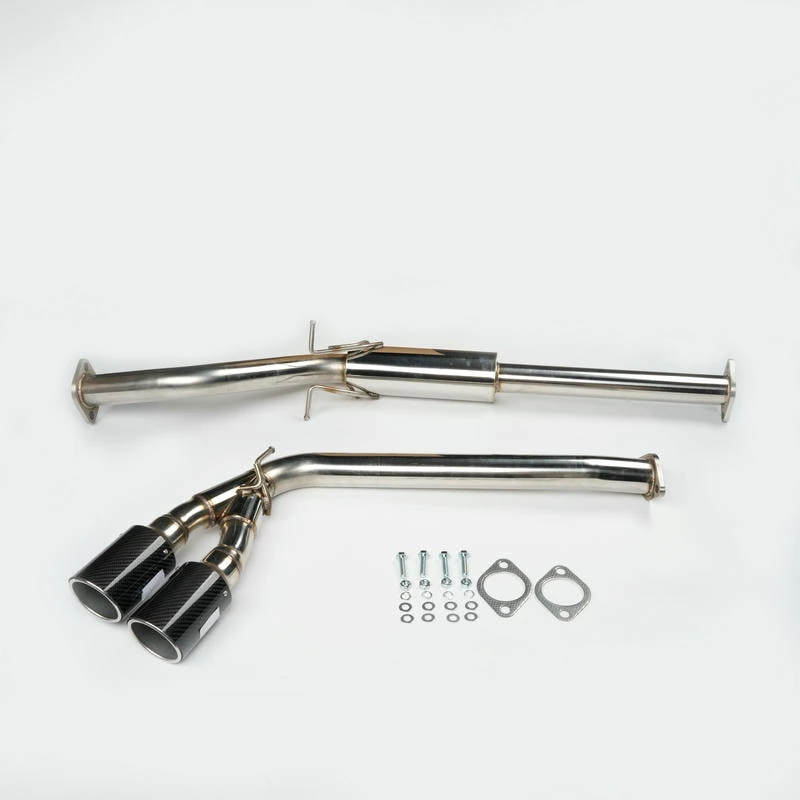
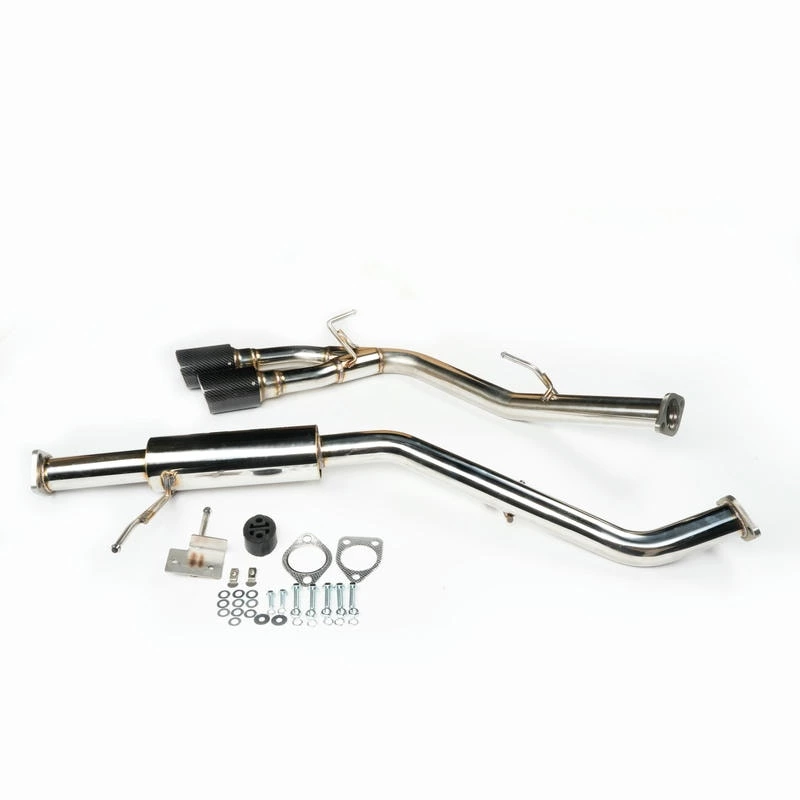
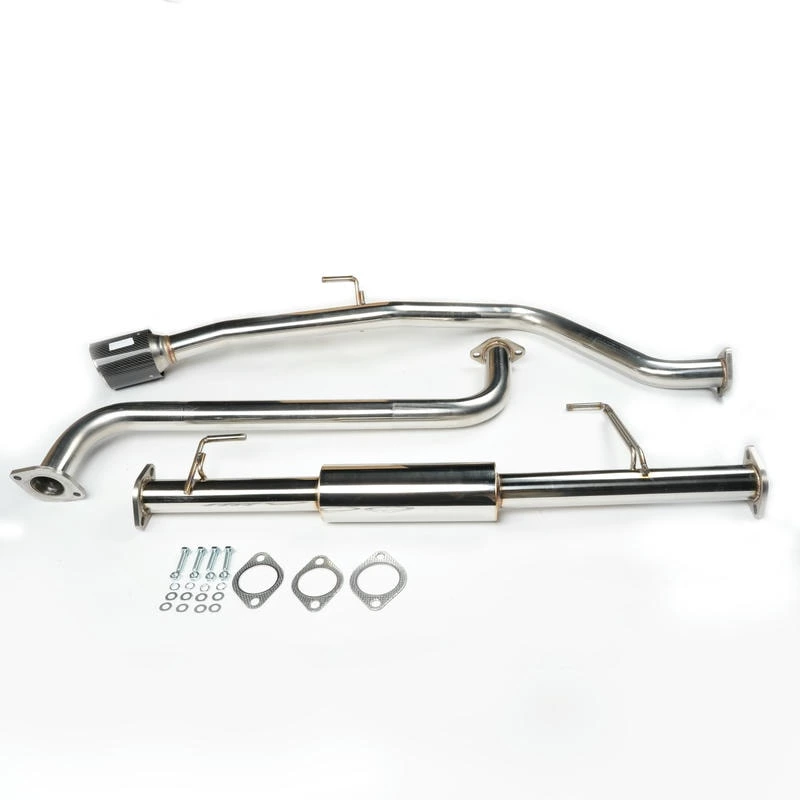
AOSU provides OEM and custom exhaust pipe solutions based on vehicle information, technical drawings, physical samples, materials, and project requirements.
Frequently Asked Questions About Exhaust Drone
What does exhaust drone sound like?
Exhaust drone usually sounds like a deep, continuous booming or humming noise inside the cabin. It often feels stronger than normal exhaust sound and may create a pressure-like sensation during steady cruising.
At what RPM does exhaust drone occur?
There is no universal RPM range. The exact engine speed depends on engine firing frequency, transmission gearing, exhaust pipe dimensions, muffler and resonator design, and vehicle structure. Drone typically appears within a relatively narrow RPM band rather than across the entire rev range.
Why does my exhaust drone on the highway?
Highway cruising often keeps the engine at a nearly constant RPM for long periods. If that RPM corresponds with a resonant frequency in the exhaust system or vehicle cabin, the low-frequency sound can become continuous and more noticeable.
Will a resonator reduce exhaust drone?
A correctly selected resonator can reduce certain frequencies associated with exhaust drone. However, its effectiveness depends on resonator design, size, location, and the frequency that needs to be controlled.
Does a straight pipe cause exhaust drone?
A straight pipe does not guarantee drone, but removing mufflers or resonators can increase the likelihood that problematic frequencies reach the vehicle cabin. Pipe diameter, length, engine characteristics, and vehicle layout still play important roles.
Can a muffler reduce exhaust drone?
A muffler can help reduce exhaust sound and may reduce some low-frequency resonance. However, if the drone is concentrated at a specific frequency, a resonator or other tuned solution may be more effective than simply installing a quieter muffler.
Is exhaust drone harmful to the engine?
Acoustic exhaust drone itself is primarily a noise and comfort issue rather than a direct sign of engine damage. However, similar vibrations can also result from damaged hangers, loose components, exhaust leaks, or contact between the exhaust and vehicle body, so unusual noises should still be inspected.
Conclusion
Exhaust drone is more than simply a loud exhaust. It is a low-frequency resonance that develops when exhaust-generated sound interacts with the acoustic characteristics of the pipework, vehicle body, and cabin.
Pipe diameter, pipe length, mufflers, resonators, exhaust routing, hangers, engine speed, and vehicle structure can all influence whether drone occurs and how strongly it is felt inside the vehicle.
The most effective way to reduce drone is to first identify the RPM and driving condition where it occurs, then determine whether the cause is acoustic resonance, exhaust geometry, mounting, or mechanical contact.
For custom and OEM exhaust systems, considering noise and resonance during the design stage can help achieve a better balance between exhaust flow, sound, fitment, and driving comfort.
If you need a vehicle-specific exhaust pipe or custom exhaust system for your project, contact AOSU with your vehicle information, drawings, samples, and technical requirements.