Toyota Vitz Exhaust System Guide: Fitment, Layout & Replacement
A Toyota Vitz exhaust system may look relatively simple from underneath the car, but finding the correct replacement pipe is not always as straightforward as matching the model name and year. The Vitz has existed across multiple generations, engine configurations, drivetrain layouts, and regional specifications, all of which can affect pipe routing, flange orientation, hanger position, sensor location, and connection geometry.
That is why two exhaust components described online as “Toyota Vitz exhaust pipes” are not automatically interchangeable. A pipe can have the correct general shape and still fail to fit because one flange is rotated differently, a hanger sits in another position, or the bend geometry does not match the vehicle underbody.
For replacement buyers, distributors, and OEM projects, the safest approach is to identify the exact vehicle configuration first and then compare the physical connection points of the existing and replacement exhaust parts.
Quick Answer: Toyota Vitz exhaust fitment should be confirmed using the vehicle generation, model year, engine, market specification, original part information, pipe routing, flange pattern, hanger locations, sensor positions, and connection dimensions. Model name alone is not enough.
Toyota Vitz Generations at a Glance
Toyota introduced the Vitz in Japan in 1999. A fully redesigned second generation followed in 2005, and the third generation arrived in December 2010. These generation changes matter when sourcing exhaust components because a new vehicle platform can change underbody packaging, drivetrain layout, engine options, mounting points, and exhaust routing.
| Vitz Generation | Introduction | Fitment Consideration |
|---|---|---|
| First Generation | 1999 | Early Vitz platform; exhaust parts should be matched to engine, drivetrain and market specification |
| Second Generation | 2005 | Multiple engine and drivetrain variants mean one exhaust layout should not be assumed to fit every model |
| Third Generation | 2010 | Later chassis and exhaust packaging require generation-specific fitment verification |
Generation is an important first filter, but it is not the final answer. Even within the same Vitz generation, different engines and drivetrain configurations can require different exhaust components.
Toyota's own specifications for the second-generation Vitz, for example, list several model codes and engine combinations, including 1.0-, 1.3-, and 1.5-liter applications. This is a useful reminder that “2005 Vitz” or “2008 Vitz” is still not enough information for precise exhaust fitment.
Toyota Vitz and Toyota Yaris: Are the Exhaust Parts the Same?
The Vitz and Yaris names are closely related, which often creates confusion when searching for exhaust parts.
Toyota introduced the first-generation car as the Yaris in Europe and sold it in Japan under the Vitz name. Because the vehicles share common platform origins, catalogs, online listings, and aftermarket suppliers may sometimes reference Vitz and Yaris together.
That does not mean every Vitz exhaust component can automatically be installed on every Yaris of a similar year.
Regional versions can differ in:
- Engine specification
- Emission-control equipment
- Catalytic converter configuration
- Oxygen-sensor position
- Pipe routing
- Flange and gasket design
- Hanger position
- Rear muffler and outlet configuration
The correct approach is therefore to treat “Vitz” and “Yaris” as useful model-family information, not as proof of direct exhaust interchangeability.
Fitment Rule: A shared vehicle platform does not guarantee identical exhaust geometry. Always verify the actual engine, connection points, mounting positions and pipe layout.
Toyota Vitz Exhaust System Layout
The exact Toyota Vitz exhaust layout varies by generation and engine, but the exhaust path generally moves gases from the engine toward the rear of the vehicle through several functional sections.
Depending on the specific application, these may include the exhaust manifold or manifold-integrated catalyst, catalytic converter section, front pipe, intermediate or center pipe, resonator, rear muffler, and tailpipe.
Engine → Exhaust Manifold → Catalytic Section → Front / Center Pipe → Muffler → Tailpipe
This simplified sequence is useful for understanding the system, but replacement parts are not always divided at exactly the same locations. One supplier may offer a long center-and-rear assembly while another may separate the system into several shorter sections.
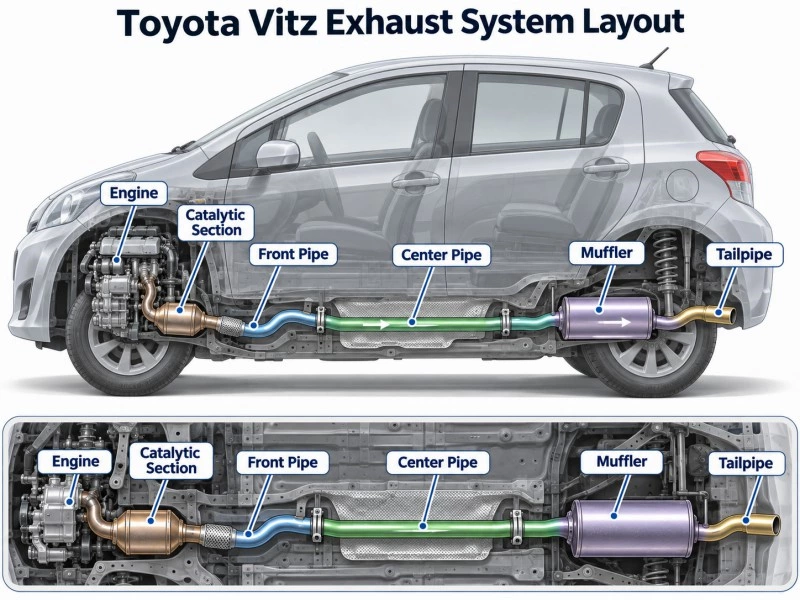
Front Exhaust Section
The front section carries high-temperature exhaust gas away from the engine and catalytic area. Depending on the Vitz configuration, this section may include flanges, oxygen-sensor provisions, flexible sections, or interfaces with the catalytic converter.
Fitment errors near the front of the system can be especially problematic because the pipe has limited freedom to move once connected to the engine-side exhaust components.
Center Pipe
The center section routes exhaust gases beneath the floor toward the rear of the car. Its geometry must follow the available underbody space while maintaining clearance from structural members, heat shields, fuel-system components, and other parts.
A center pipe that is only slightly wrong in bend position or rotation can fit at the front connection but end up several centimeters away from the rear muffler or hanger.
Rear Muffler and Tailpipe
The rear section controls part of the exhaust noise and directs gases away from the vehicle. Its position is influenced by the rear suspension, bumper, underbody layout, and hanger locations.
Tailpipe alignment therefore depends on the complete system being positioned correctly rather than simply adjusting the final outlet.
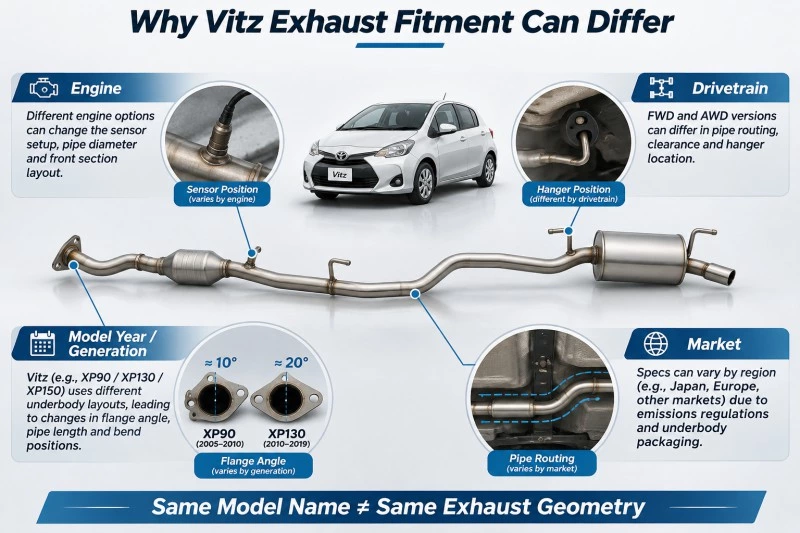
Why Toyota Vitz Exhaust Fitment Varies
One of the most common mistakes when ordering replacement exhaust parts is assuming that model year alone determines compatibility.
In practice, several variables can change the exhaust system.
Engine Configuration
Different engines can use different exhaust manifold outlets, catalytic arrangements, pipe diameters, flange positions, and sensor locations.
This is particularly important on the Vitz because the model has been offered with several engine capacities across its production history. The pipe used behind one engine should not be assumed to match another simply because the body shape is similar.
Drivetrain Layout
Front-wheel-drive and four-wheel-drive versions can require different underbody routing because drivetrain hardware occupies different space beneath the vehicle.
When the available packaging space changes, bend positions, hanger locations and pipe routing may also need to change.
Market Specification
A Japanese-market Vitz and an export-market vehicle from the same model family may use different emissions equipment or exhaust specifications.
For this reason, a part listing that only states “Toyota Vitz/Yaris” without identifying the target market, engine, or chassis information should be checked carefully before ordering.
Production Changes
Vehicle manufacturers can revise parts during a model's production life. A mounting bracket, flange, sensor location, catalyst arrangement, or downstream pipe may change without the vehicle receiving an entirely new model name.
For difficult applications, build date and original part information can therefore be more useful than relying only on registration year.
How to Identify the Correct Toyota Vitz Exhaust Pipe
The most reliable way to identify a replacement pipe is to work from the vehicle specification toward the physical component rather than starting with appearance alone.
Recommended Identification Sequence:
Generation → Model Year → Engine → Market / Drivetrain → Original Part Information → Physical Exhaust Geometry
1. Confirm the Vehicle Information
Start with the basic vehicle data:
- Toyota Vitz model year
- Engine code or engine capacity
- Drivetrain configuration
- Vehicle identification information
- Market or country specification
For B2B sourcing, including a clear photo of the vehicle identification plate and the original exhaust component can reduce ambiguity when several variants exist.
2. Check the Original Part Number
If the Toyota or existing replacement part number is still readable, use it as an additional cross-reference.
A part number is useful, but it should still be checked against the actual application when dealing with aftermarket replacements, older vehicles, or exhaust systems that may have been modified previously.
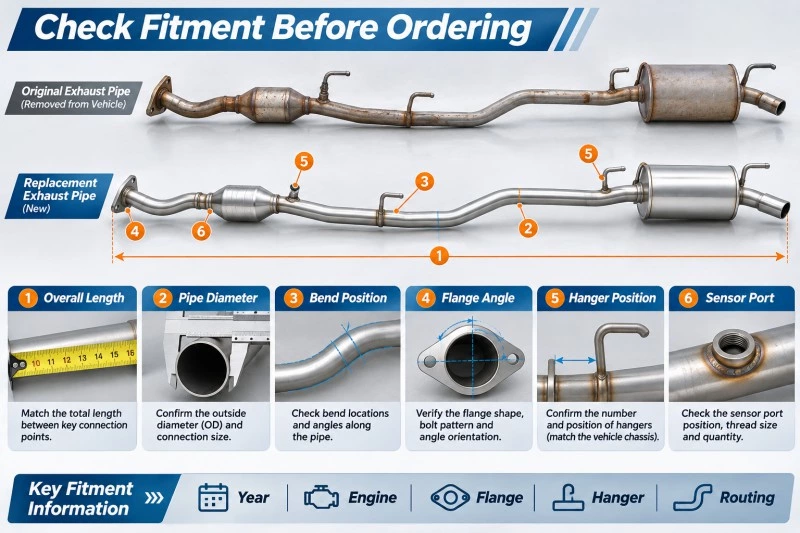
3. Compare the Existing Exhaust Pipe
Before ordering or installing a replacement, compare the original pipe with the proposed component.
Important reference points include:
- Overall length
- Outside pipe diameter
- Bend locations
- Bend directions
- Flange shape and orientation
- Bolt pattern
- Hanger number and position
- Connection-end design
- Sensor or threaded-port location
For detailed measurement methods, see our exhaust pipe measurement guide.
Key Fitment Points to Check Before Ordering
A good fitment check should focus on interfaces and geometry, not only on pipe material or appearance.
| Fitment Point | What to Check | What Can Go Wrong |
|---|---|---|
| Pipe Diameter | Outside diameter and mating connection size | Pipe cannot enter the joint or clamp cannot seal correctly |
| Flange | Bolt count, bolt spacing, flange angle and gasket type | Bolts do not align or flange joint leaks |
| Bend Geometry | Bend position, angle and rotation | Pipe contacts the underbody or misses the downstream connection |
| Hangers | Number, orientation and mounting location | Rubber mounts are stretched or cannot reach |
| Sensor Ports | Number, thread and position where applicable | Sensor cannot be installed or wiring cannot reach safely |
| Overall Length | Distance between critical connection points | System becomes compressed, stretched or misaligned |
Flange Geometry Is More Important Than It Looks
Two pipes can have the same diameter while using different flange designs.
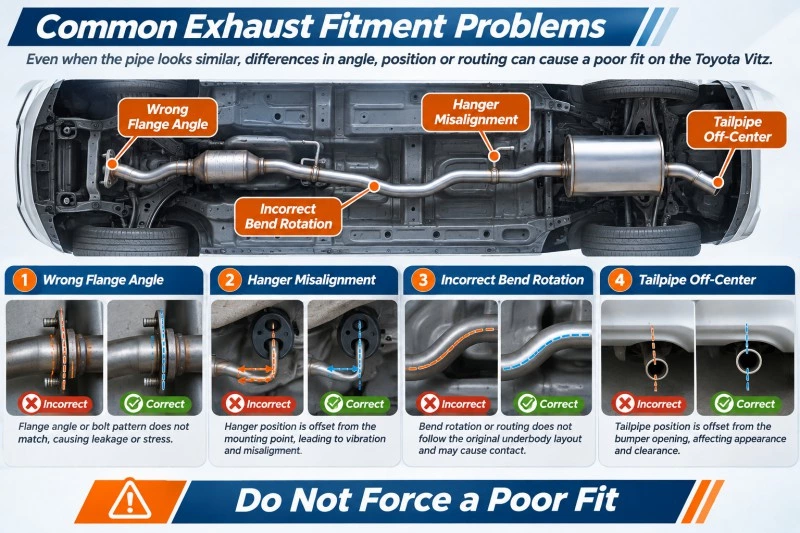
The number of bolts, bolt spacing, sealing face, gasket type, and flange rotation all affect compatibility. Using bolts to pull a badly misaligned flange into place is not a proper fitment solution because it can place stress into the pipe and sealing joint.
Hanger Position Controls More Than Support
Exhaust hangers do more than prevent the system from falling. They establish the working position of the pipe under the vehicle while allowing controlled movement from vibration and thermal expansion.
If the hanger rod is welded in the wrong location, the rubber isolator may be stretched to force the pipe into place. That can change tailpipe position, reduce clearance, and introduce stress into welded areas.
Pipe Routing Must Be Checked in Three Dimensions
Looking at a pipe from the side can hide an important fitment problem. Exhaust systems use bends in multiple planes, so rotation between bends matters just as much as the bend angle itself.
A small rotational error near the front can move the rear section significantly away from the intended hanger or muffler location.
Common Toyota Vitz Exhaust System Problems
Exhaust components operate in an environment of heat, moisture, road debris, vibration, and repeated thermal expansion. Over time, several problems can develop.
Corrosion and Rust-Through
External corrosion is often most visible around welded seams, flanges, clamps, and low areas where moisture and road contamination accumulate.
Surface discoloration does not automatically mean a pipe requires replacement, but deep scaling, perforation, or material loss around a structural connection deserves closer inspection.
Exhaust Leaks at Joints
Leaks can occur where flanges, gaskets, slip joints, clamps, or welded sections no longer seal correctly.
Common signs include ticking or hissing noises, visible soot near a connection, increased exhaust noise, or exhaust odor.
Broken or Deteriorated Hangers
Rubber isolators can harden, crack, stretch, or tear with age. Metal hanger rods can also become damaged or corroded.
A failed hanger allows excessive system movement and may cause the pipe or muffler to contact the vehicle body.
Rattling or Underbody Contact
Rattling is not always caused by an internal muffler problem. The pipe may be contacting a heat shield, body panel, crossmember, or another component because of a bent hanger, impact damage, or incorrect installation alignment.
Impact Damage
Because sections of the exhaust run beneath the vehicle, road impact can flatten tubing, move hangers, distort flanges, or change pipe geometry.
This is especially important when using an old exhaust pipe as a sample for replacement manufacturing: a damaged pipe should not automatically be copied dimension for dimension.
When Does a Toyota Vitz Exhaust Pipe Need Replacement?
Not every noisy or rusty exhaust requires the complete system to be replaced. The decision should be based on the condition and function of the affected section.
Replacement becomes more reasonable when the pipe has:
- Rust perforation or significant material loss
- Cracking around a weld or hanger
- Severe impact deformation
- A flange that can no longer seal correctly
- Repeated leakage from badly deteriorated pipe ends
- Geometry damage that causes contact with the chassis
A small removable connection problem may sometimes be repaired with the correct gasket, clamp, fastener, or joint component. By contrast, adding multiple sleeves or adapters to compensate for a badly damaged or incorrect pipe can create more alignment and leakage problems.
For broader replacement considerations, see our exhaust pipe replacement guide if that URL matches your current published page.
Toyota Vitz Exhaust Pipe Replacement: What to Check Before Installation
Once the correct replacement component has been selected, installation should still begin with a comparison between the old and new parts.
Place the Old and New Parts Side by Side
Compare the two pipes before installing the replacement.
Do not look only at total length. Check:
- Where each bend begins and ends
- The direction of each bend
- Flange rotation
- Hanger positions
- Pipe-end diameters
- Sensor-port locations
A mismatch identified on the workshop floor is much easier to correct than one discovered after half of the new exhaust has been tightened under the car.
Install Loosely Before Final Tightening
Exhaust components should generally be positioned and aligned before all clamps and flanges are fully tightened.
This allows the system to settle naturally into its hanger positions and helps prevent one joint from forcing the remaining exhaust out of alignment.
Check Clearance Under the Vehicle
Once positioned, inspect clearance around the floor, heat shields, suspension components, chassis structures, fuel-system components, and rear bumper.
Remember that the exhaust moves during operation. Engine movement, road vibration, suspension travel, and thermal expansion mean that a pipe barely clearing another part while stationary may still contact it while driving.
Our exhaust pipe installation guide covers alignment, hanger positioning, tightening and leak checks in more detail.
Why a New Toyota Vitz Exhaust Pipe May Not Line Up
A replacement pipe that refuses to line up should not immediately be forced into position.
The cause usually falls into one of several categories.
Wrong Vehicle Variant
The part may be intended for another engine, generation, drivetrain or market specification.
Incorrect Orientation
Some sections can appear similar when rotated, particularly before all hangers and adjoining components are connected.
Existing Exhaust Damage
The replacement part may be correct while the remaining exhaust system has been bent, repaired, or repositioned previously.
Dimensional Variation
Poorly controlled bend position, flange angle, hanger placement, or overall length can make an aftermarket pipe difficult to install even when the application description appears correct.
Connections Were Tightened Too Early
Fully tightening the front connection before positioning the remaining system can lock the pipe at the wrong angle and create an apparent mismatch farther back.
Do not solve a major fitment error by applying more force. Exhaust pipes should follow the intended vehicle geometry without excessive bending, stretching of rubber hangers, or pulling flanges together with bolts.
OEM vs Replacement Toyota Vitz Exhaust Pipes
The useful distinction between OEM and aftermarket exhaust parts is not simply which one is “better.” For a replacement buyer, the more important question is whether the component reproduces the geometry and interfaces required by the specific vehicle.
A replacement exhaust pipe should accurately control:
- Pipe outside diameter
- Overall geometry
- Bend positions and rotations
- Flange angle and bolt pattern
- Hanger coordinates
- Connection dimensions
- Sensor-port locations where required
Material and weld quality matter for durability, but a beautifully welded stainless steel pipe still creates a poor replacement product if its hangers or flanges do not align with the vehicle.
For B2B exhaust sourcing, dimensional consistency is therefore as important as material specification.
Toyota Vitz Exhaust Pipe Specifications for OEM Projects
Distributors, aftermarket brands, and replacement-parts suppliers developing a Vitz exhaust product should provide more information than the vehicle name alone.
Useful development information includes:
| Information | Why It Is Needed |
|---|---|
| Vehicle year / generation | Defines the basic platform |
| Engine code | Helps identify engine-side exhaust configuration |
| Target market | Helps account for regional exhaust and emissions differences |
| OEM or reference part number | Provides an additional fitment reference |
| Original physical sample | Provides real-world geometry for reverse engineering |
| Technical drawing | Defines measurable production dimensions and tolerances |
| Material | Defines corrosion, forming and manufacturing requirements |
| Pipe OD and wall thickness | Controls connections, bending tooling and weight |
| Expected quantity | Helps determine tooling and production planning |
For a sample-based project, the existing pipe can be reverse engineered into manufacturing dimensions. Critical features such as bend centerlines, flange orientation, hanger coordinates and connection geometry then become references for tooling, fixtures and inspection.
For more detail on this process, see how custom exhaust pipes are made from drawings or samples.
Toyota Vitz Exhaust Solutions from AOSU
AOSU manufactures Toyota exhaust pipe and exhaust system products for vehicle-specific applications and also supports OEM development based on drawings, physical samples and project requirements.
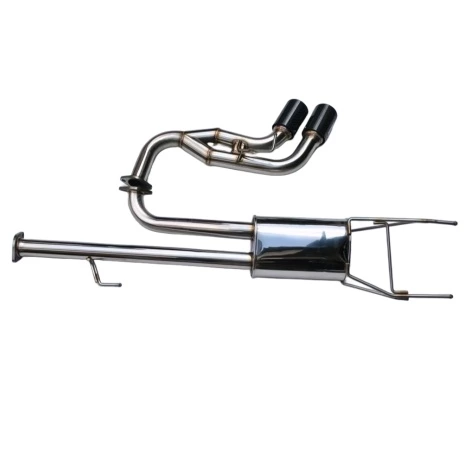
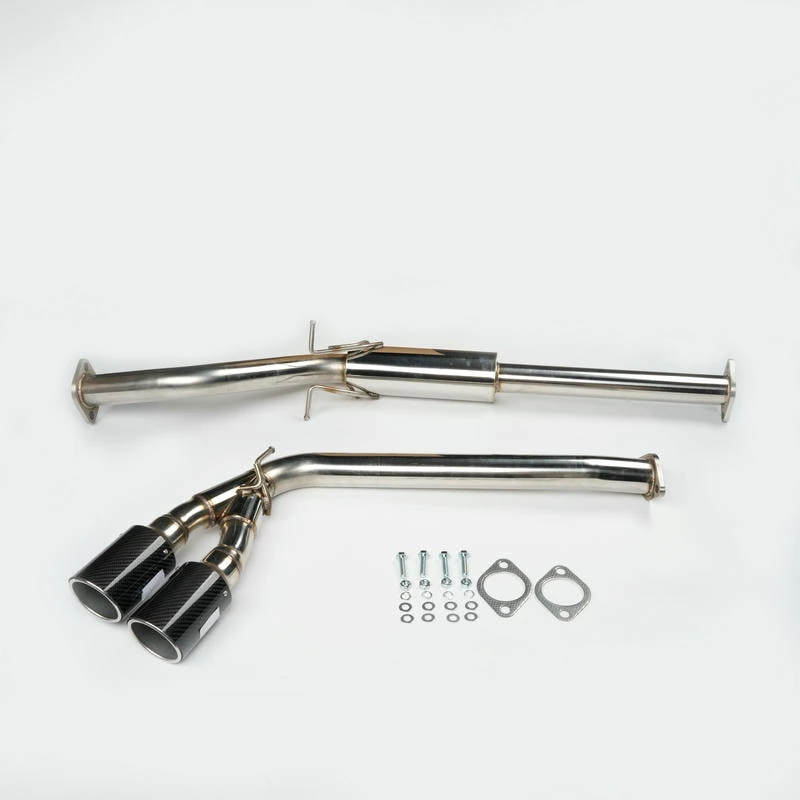
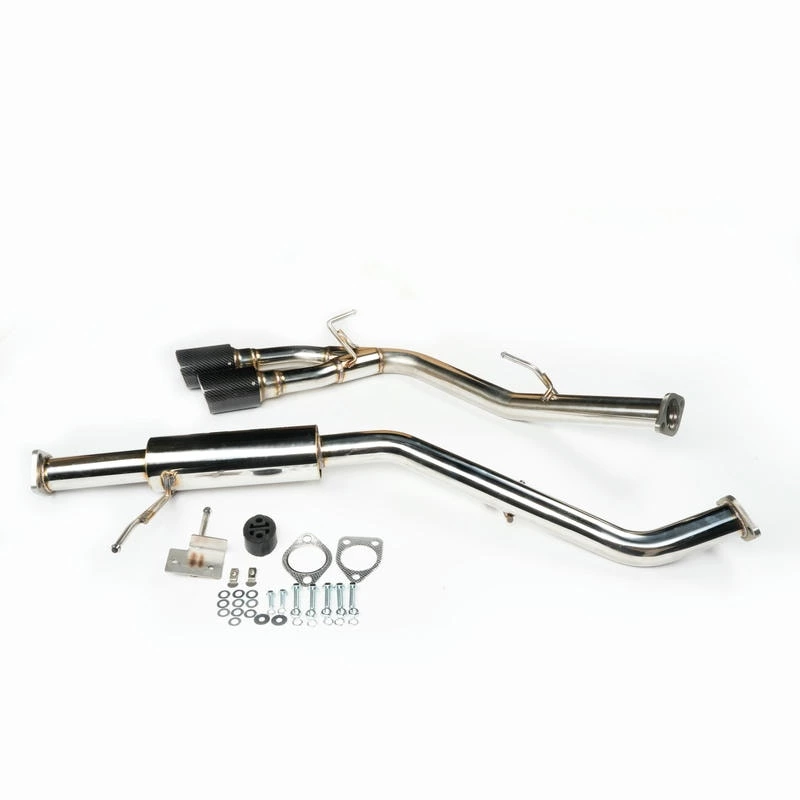
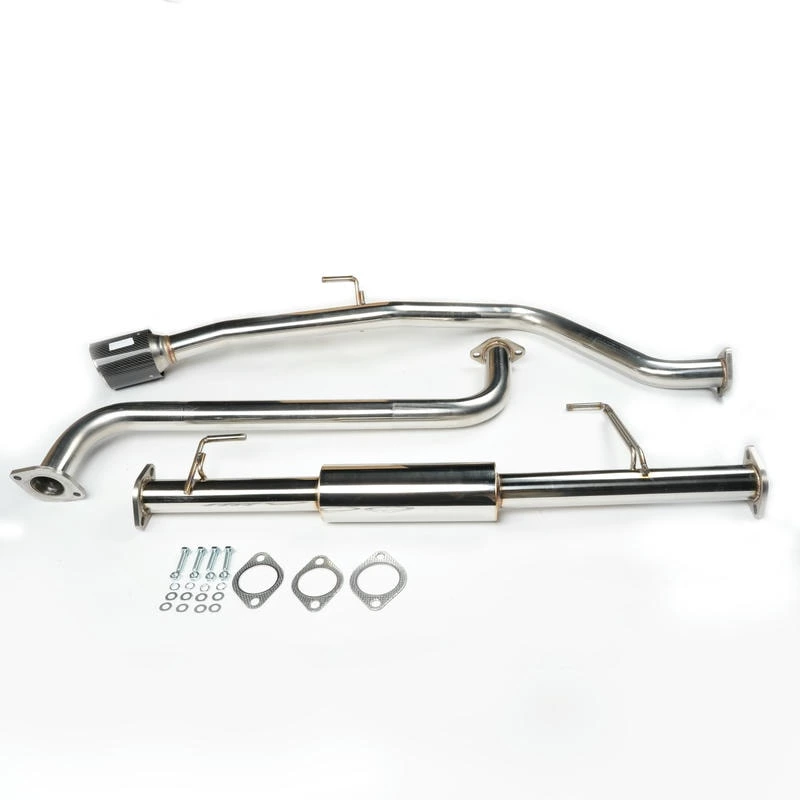
For Toyota Vitz applications, fitment should always be confirmed against the specific engine, year and vehicle configuration before ordering. AOSU currently offers a vehicle-specific Vitz GR Sport exhaust application, while other Vitz requirements can be evaluated according to the supplied vehicle and dimensional information.
Custom development can include:
- Sample measurement and reverse engineering
- Stainless steel tube specification
- CNC tube bending
- Flange and hanger positioning
- Welding and assembly
- Fixture-based dimensional control
- Prototype inspection
- Batch production
The objective for a vehicle-specific replacement is not simply to manufacture a pipe that looks similar. The finished component must place every critical connection and mounting point where the vehicle expects it to be.
Toyota Vitz Exhaust Fitment Checklist
Before buying or approving a replacement Vitz exhaust pipe, confirm the following:
| Check | Confirmed |
|---|---|
| Correct Vitz generation and model year | □ |
| Correct engine / engine code | □ |
| Correct market and drivetrain configuration | □ |
| Original part number cross-checked where available | □ |
| Pipe diameter matches | □ |
| Flange shape and bolt pattern match | □ |
| Bend routing matches the original | □ |
| Hanger number and positions match | □ |
| Sensor ports match where applicable | □ |
| Connection ends and overall length match | □ |
Frequently Asked Questions About the Toyota Vitz Exhaust System
Is the Toyota Vitz exhaust the same as the Toyota Yaris exhaust?
Not necessarily. Vitz and Yaris models can share platform relationships, but exhaust compatibility still depends on generation, engine, market, drivetrain, emissions configuration and physical connection geometry. Verify the actual part before treating them as interchangeable.
Will an exhaust from one Vitz year fit another year?
It may fit when both vehicles share the same relevant configuration, but year alone cannot confirm compatibility. Generation, engine, flange design, hanger positions, pipe routing and other fitment points should be checked.
How do I know which Toyota Vitz exhaust pipe I need?
Start with the vehicle year, engine code, drivetrain and market specification. Then cross-reference the original part number where available and compare the physical pipe diameter, bends, flanges, hangers and connections.
Why does my replacement Vitz exhaust pipe not line up?
Possible causes include the wrong vehicle variant, incorrect pipe orientation, existing damage to the remaining exhaust, incorrect hanger or flange geometry, dimensional variation, or tightening another connection before the complete exhaust was aligned.
Can a Toyota Vitz exhaust pipe be reproduced from the original sample?
Yes. A physical sample can be reverse engineered by measuring its tube diameter, bend geometry, flange orientation, hanger positions and connection points. For repeat production, those measurements should be converted into documented manufacturing and inspection data rather than relying only on visual copying.
Should I replace the whole Toyota Vitz exhaust system if one pipe is damaged?
Not always. The correct repair depends on the location and extent of the damage. A single deteriorated pipe or connection may be replaceable separately if the surrounding exhaust components remain structurally sound and compatible.
Conclusion
Correct Toyota Vitz exhaust system fitment starts with identifying the vehicle accurately. The Vitz has passed through several generations and has been offered with different engines, drivetrain configurations and regional specifications, so model name and year should not be treated as the only compatibility criteria.
Before ordering a replacement exhaust pipe, check the engine, vehicle configuration, original part information, pipe diameter, bend geometry, flanges, hanger positions, sensor provisions and connection ends. These physical details determine whether the new component will actually sit naturally beneath the vehicle.
For distributors and OEM buyers, the same principle applies at the manufacturing stage. Reliable replacement exhaust pipes require controlled bending, accurate flange and hanger positioning, suitable fixtures and dimensional inspection so that production parts reproduce the approved vehicle-specific geometry.
For Toyota Vitz replacement or OEM exhaust projects, contact AOSU with your vehicle information, original part number, photos, drawing or physical sample for fitment evaluation.