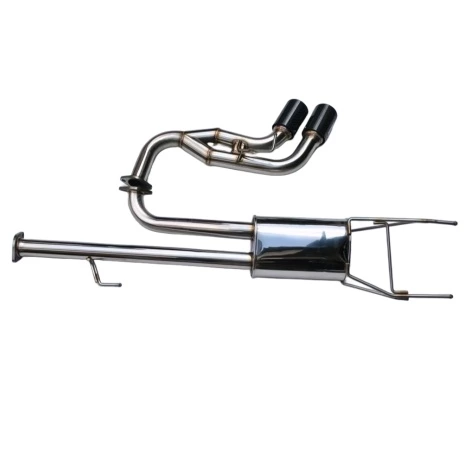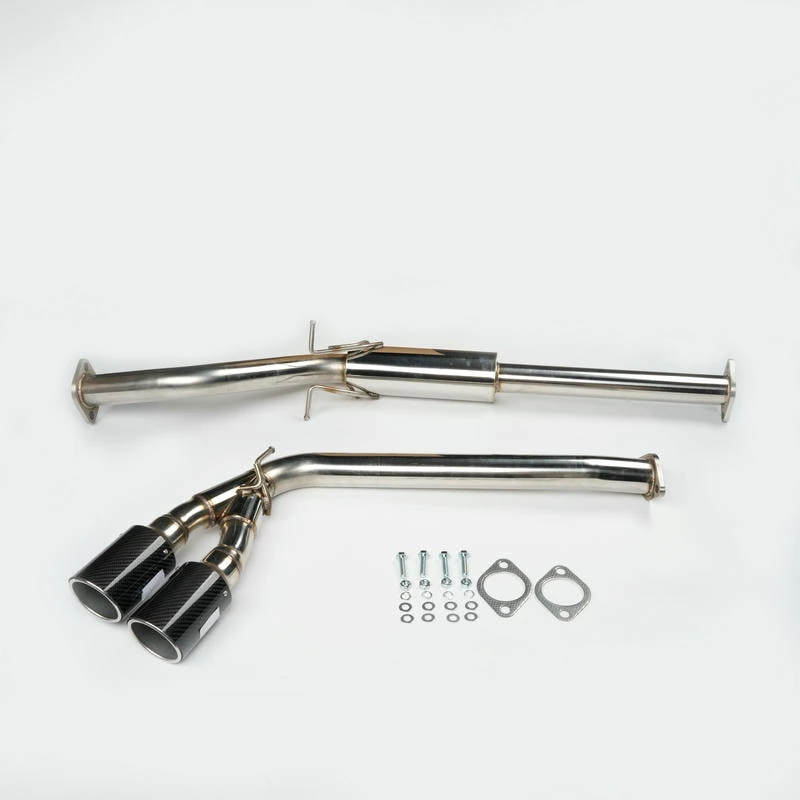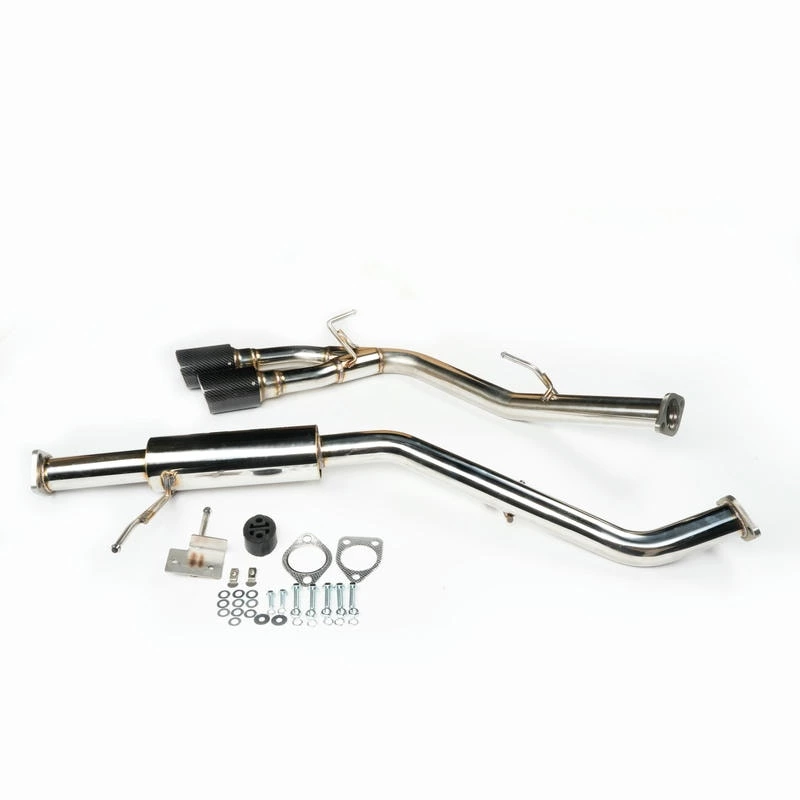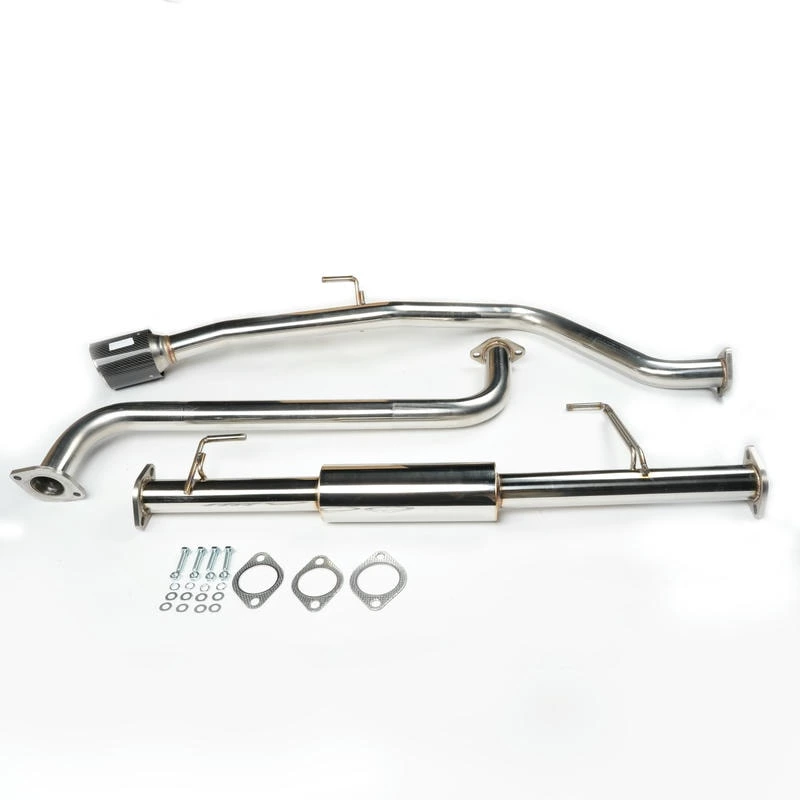
Isuzu D-Max Exhaust System Guide: Fitment, Layout & Replacement
Choosing the correct Isuzu D-Max exhaust system requires more than matching a model name or production year. The D-Max has been sold with different diesel engines, drivetrains, cab configurations, emissions systems, and regional specifications, all of which can change the exhaust layout.
A replacement pipe may appear almost identical to the original yet still fail to fit because the flange angle, DPF connection, hanger position, bend rotation, or overall length differs. These differences become especially important on modern diesel models, where the exhaust is also part of the emissions-control system rather than simply a path from the engine to the tailpipe.
For owners, distributors, and replacement-parts buyers, the safest way to identify a D-Max exhaust is to work from the exact vehicle configuration toward the physical pipe geometry.
Quick Answer: Confirm the D-Max model year, engine code, drivetrain, body configuration, market specification, DPF/DPD setup, flange geometry, pipe routing, hanger locations, and connection dimensions before ordering a replacement exhaust.
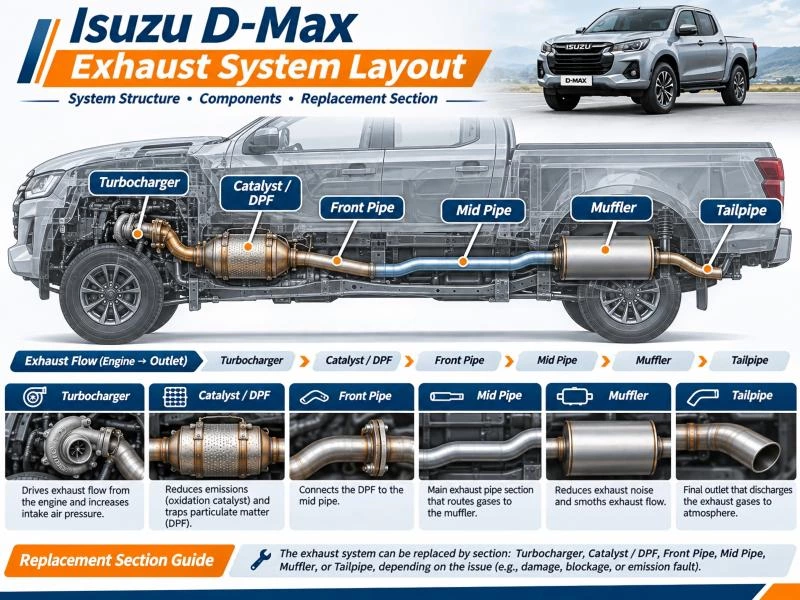
Isuzu D-Max Exhaust System Layout
The exact layout varies by generation and market, but a modern turbo-diesel D-Max typically routes exhaust gases from the turbocharger through emissions-control components before sending them through the downstream pipework, muffler, and tailpipe.
Turbocharger → Catalyst / Emissions Section → DPF or DPD → Front / Mid Pipe → Muffler → Tailpipe
This sequence is deliberately simplified. Some versions integrate components differently, and later vehicles may include additional emissions hardware such as selective catalytic reduction equipment. The important point is that the front half of the system is closely tied to engine and emissions configuration, while the rear half is strongly influenced by chassis routing, drivetrain, wheelbase, and body style.
Turbo and Front Exhaust Section
The front exhaust section operates under the highest temperature and pressure conditions in the system. It connects directly or indirectly to the turbocharger and normally contains tightly controlled interfaces for catalysts, sensors, and emissions components.
Because space around the engine, transmission, and front chassis structure is limited, small differences in flange position or pipe routing can make a replacement component incompatible even if the nominal pipe diameter is correct.
DPF / DPD Section
Many later D-Max diesel models use a particulate-filter system. Isuzu commonly refers to its system as a Diesel Particulate Diffuser (DPD), while the broader industry term DPF is also widely used.
Its purpose is to trap particulate matter from diesel exhaust. When the accumulated soot reaches a calculated level, the vehicle initiates a regeneration process that raises exhaust temperature and burns off the trapped particulate.
This means the DPD/DPF is not just another muffler-like component. Its position, sensor interfaces, temperature conditions, and downstream geometry form part of the vehicle's emissions-control strategy.
Important: A DPF or DPD warning should not automatically be diagnosed as an exhaust-pipe failure. Regeneration problems, sensor faults, soot loading, driving conditions, or other engine-management issues may be involved and should be diagnosed separately.
Mid Pipe and Rear Section
Downstream of the emissions section, the pipe runs beneath the vehicle toward the rear muffler and tailpipe.
This section must clear crossmembers, transmission components, the driveshaft, rear axle, suspension movement, spare-wheel area, and body structure. The routing therefore depends heavily on the specific chassis configuration.
The rear section also carries several hangers that support the system while allowing controlled movement from engine vibration and thermal expansion.
Why Isuzu D-Max Exhaust Fitment Varies
The D-Max name covers a wide range of vehicles. Treating all of them as one exhaust application is one of the fastest ways to order the wrong part.
Engine Code
Engine identification is one of the most important fitment checks.
D-Max applications can use different diesel engines, including 1.9L and 3.0L units. These engines do not necessarily share the same turbo outlet, emissions hardware, pipe diameter, connection position, or downstream geometry.
For this reason, a product description that only says “Isuzu D-Max exhaust” is incomplete. The engine code should be treated as a primary identifier.
Generation and Model Year
Major model changes can alter chassis architecture, engine placement, emissions systems, and exhaust routing. Even within one generation, running changes may affect sensor placement, brackets, or connecting components.
A year range is therefore useful, but it should not replace engine and vehicle-specific verification.
4x2 vs 4x4
Drivetrain configuration can change the space available beneath the vehicle.
A 4x4 system may need to route around transfer-case components, additional driveline hardware, or different underbody structures. As a result, a pipe that fits one drivetrain may contact the chassis or fail to reach a hanger on another.
Cab and Chassis Configuration
D-Max models are offered in different body formats, including single-cab, extended-cab and crew-cab variants, as well as ute and cab-chassis configurations in some markets.
Wheelbase and rear-body differences can affect:
- Overall exhaust length
- Rear hanger position
- Tailpipe routing
- Muffler location
- Clearance around rear chassis components
Market Specification
Vehicles sold in different markets may use different emissions hardware, calibrations, sensor arrangements, noise-control components, or exhaust routing.
This is why two D-Max vehicles with the same engine capacity and similar production year should still be checked against the target market and original exhaust geometry.
DPF-Back vs Turbo-Back: Understanding the Difference
These terms appear frequently when discussing D-Max exhaust systems, but they describe where the replacement system begins rather than guaranteeing a particular performance result.
| System Type | Starting Point | Factory DPF / DPD | Main Fitment Concern |
|---|---|---|---|
| DPF-Back | Downstream of the particulate filter | Normally retained | Rear pipe routing, hangers, muffler, diameter and outlet position |
| Turbo-Back | Turbocharger outlet | Depends on vehicle and system design | Turbo connection, emissions hardware, sensors, tuning and legal compliance |
DPF-Back Exhaust
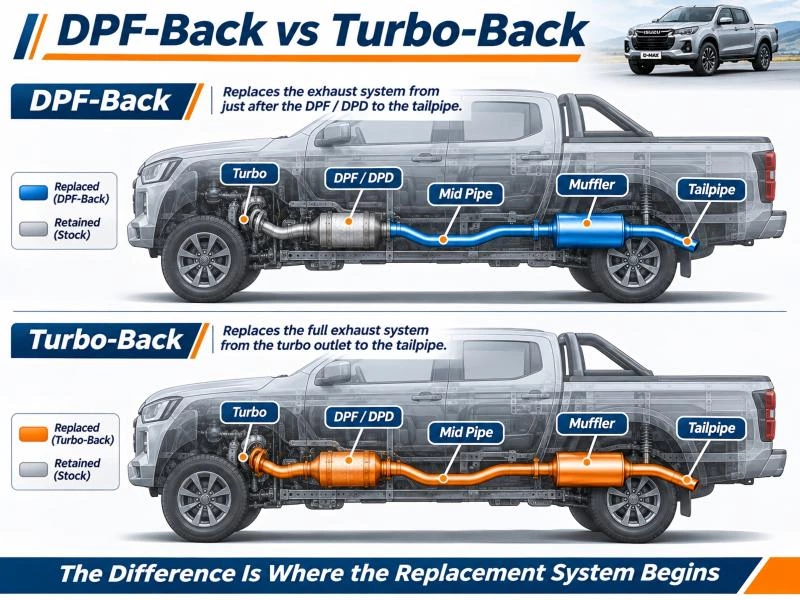
A DPF-back system replaces the exhaust downstream of the factory particulate filter. Because the filter remains in place, this type of system is usually focused on the mid and rear exhaust sections.
However, retaining the DPF does not automatically mean every DPF-back system is legally compliant in every country. Noise regulations, construction rules, certification requirements, and other local standards can still apply.
Turbo-Back Exhaust
A turbo-back system begins at the turbocharger outlet and therefore interacts with a larger portion of the exhaust system.
On vehicles equipped with modern emissions hardware, changes in this area can involve catalysts, particulate filters, temperature sensors, pressure sensors, and engine calibration. These systems should therefore be evaluated against the exact vehicle specification and applicable emissions regulations.
For a deeper explanation of the turbo-side component itself, see our downpipe guide.
How to Identify the Correct Isuzu D-Max Exhaust
A reliable fitment check should follow a defined sequence instead of comparing photos online.
Recommended Sequence:
Model Year → Engine Code → Drivetrain → Cab / Chassis → Market → DPF / DPD Configuration → Original Part → Physical Pipe Geometry
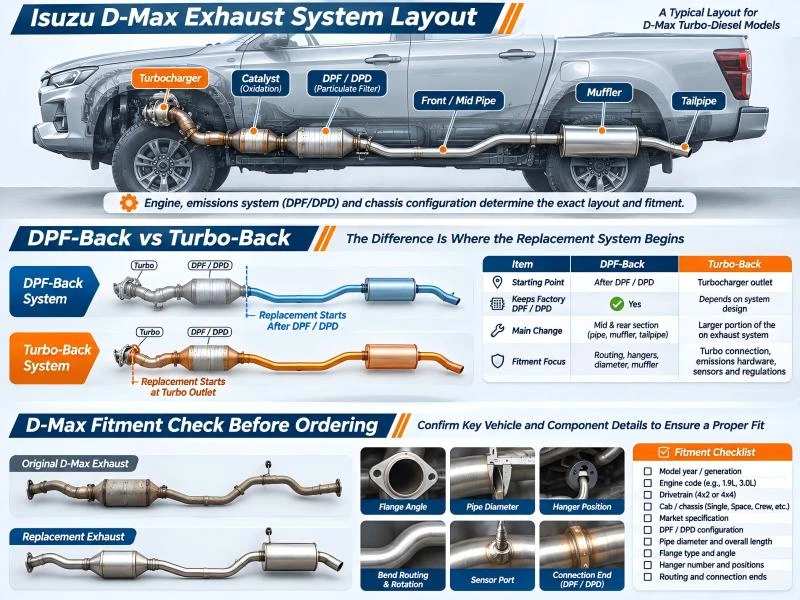
1. Confirm the Engine
Record the engine code rather than relying only on “1.9L” or “3.0L.” Engine codes provide a more precise reference when comparing vehicle applications.
AOSU currently lists separate D-Max applications for the 1.9L RZ4E-TC and 3.0L 4JJ3-TCX, which illustrates why engine identification matters in product selection.
2. Confirm the Emissions Layout
Determine whether the vehicle uses a DPF/DPD and identify where it sits relative to the section being replaced.
Do not assume a pre-filter pipe, post-filter pipe, or complete system is interchangeable simply because the engine family is similar.
3. Compare the Original Pipe
If the old component is available, compare it directly with the proposed replacement.
Check:
- Overall length
- Pipe outside diameter
- Bend positions
- Bend rotation
- Flange type and angle
- Hanger quantity and location
- Sensor or threaded-port positions
- Connection-end geometry
- DPF / DPD interface where applicable
For detailed dimensional methods, see our exhaust pipe measurement guide.
Key D-Max Exhaust Fitment Points Before Ordering
| Fitment Point | Why It Matters | Typical Result if Incorrect |
|---|---|---|
| Engine Code | Determines front-side exhaust and emissions interfaces | Wrong flange, sensor or pipe arrangement |
| DPF / DPD Position | Defines where downstream replacement sections begin | Pipe cannot connect to the emissions section |
| Flange Geometry | Controls alignment and sealing | Bolt holes do not align or joint leaks |
| Bend Rotation | Determines the 3D path under the chassis | Pipe contacts drivetrain or crossmember |
| Hanger Position | Controls natural installed position | Rubber mounts stretch or cannot reach |
| Wheelbase / Body Style | Affects downstream length and routing | Rear pipe or muffler sits in the wrong position |
| 4x2 / 4x4 | Changes available underbody space | Clearance problems around driveline components |
Isuzu D-Max 1.9L vs 3.0L Exhaust Fitment
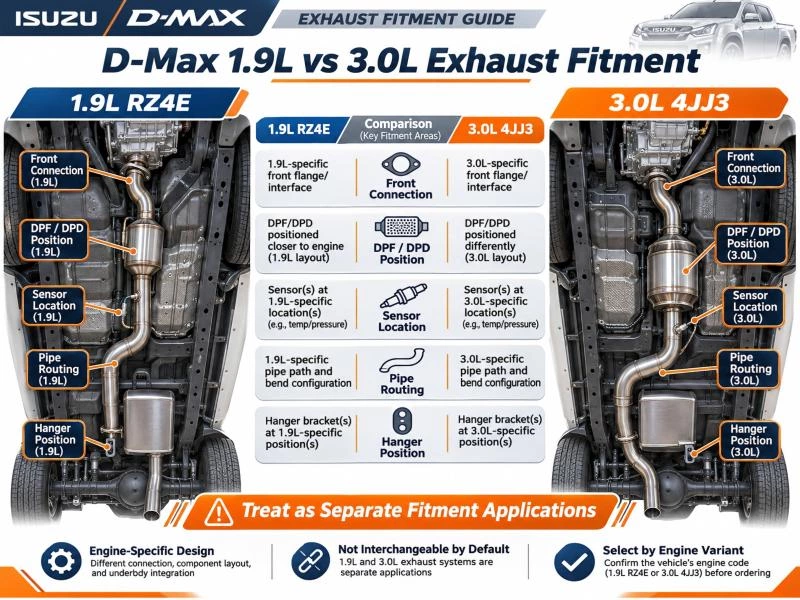
The 1.9L and 3.0L D-Max should be treated as separate exhaust applications unless confirmed otherwise by the manufacturer.
It is not enough to assume that a smaller or larger engine simply uses a different pipe diameter. Engine configuration can influence the position of the turbo outlet, emissions components, sensors, brackets, pipe routing, and downstream connections.
This is particularly important for replacement-parts buyers because a system may appear visually similar while using different mounting or connection geometry.
Practical Rule: Do not convert a D-Max exhaust application from “3.0L” to “1.9L,” or vice versa, based only on visual similarity. Verify the engine code and actual fitment points.
AOSU currently supplies separate Isuzu exhaust applications for both engine configurations and supports OEM development when a standard vehicle-specific product does not match the required application.
Common Isuzu D-Max Exhaust Problems
A D-Max can operate in environments that are much harsher than those experienced by a typical passenger car. Towing, off-road use, mud, water crossings, road debris, long-distance driving, vibration, and high exhaust temperatures all affect the system.
Exhaust Leaks
Leaks commonly develop around:
- Flange gaskets
- Clamp joints
- Welds
- Corroded pipe sections
- Damaged connection ends
Typical symptoms include ticking or hissing, increased exhaust noise, visible soot near a joint, or exhaust odor.
Corrosion
Moisture, road contamination, mud and salt can accelerate external corrosion, especially around welded joints, clamps, flanges and low points where contamination remains trapped.
Surface staining alone does not mean a pipe has failed. Replacement becomes more relevant when corrosion has caused perforation, significant wall loss or structural weakness around a connection.
Hanger and Mounting Problems
A damaged rubber isolator or bent hanger can allow excessive exhaust movement. On a pickup used on rough roads, this can lead to rattling, poor tailpipe alignment, or contact with the chassis.
Impact Damage
Off-road use increases the risk of crushing, denting or shifting exhaust sections.
A pipe can still look intact externally while its geometry has moved enough to reduce clearance or load the hangers unevenly.
DPF / DPD Warning Problems
A particulate-filter warning is not the same as a failed exhaust pipe.
The DPD/DPF depends on engine management, soot loading, temperature, sensors and regeneration conditions. Frequent short journeys or unsuitable operating conditions may make regeneration more difficult on some vehicles, but diagnosis should follow the model-specific owner information rather than a universal RPM, speed or mileage formula.
If a warning remains active, the cause should be professionally diagnosed before replacing unrelated exhaust components.
When Should a D-Max Exhaust Pipe Be Replaced?
Replacement is usually justified when the pipe itself has suffered structural or dimensional failure rather than when another exhaust-system component has developed a fault.
Replacement Is More Likely Appropriate When
- The tube is perforated by corrosion
- A weld or hanger area has cracked
- The pipe is severely crushed or deformed
- The flange can no longer seal correctly
- The connection end has deteriorated significantly
- Impact damage has changed the routing
- Repeated leakage cannot be corrected at the joint
Replacement May Not Solve the Problem When
- The DPF/DPD only needs proper diagnosis
- A sensor or wiring fault is present
- A reusable pipe is only misaligned
- A gasket or clamp is the actual failure point
- The rattle comes from a loose heat shield
Why a Replacement D-Max Exhaust May Not Fit
When a new pipe does not line up, the problem should be identified before the installer starts bending, pulling or forcing the system into position.
Wrong Engine Application
A pipe intended for another engine can differ at the front connection, emissions interface or downstream routing.
Wrong Drivetrain or Body Configuration
A 4x2/4x4 mismatch or different wheelbase can move important chassis references relative to the exhaust.
DPF / DPD Connection Mismatch
The pipe may have the wrong flange, connection diameter, angle or sensor arrangement for the installed emissions system.
Hanger Position Is Incorrect
If the rubber mount must be pulled hard to reach the hanger rod, the pipe geometry should be checked before installation continues.
Bend Rotation Is Wrong
Exhaust bends occur in three dimensions. A pipe can have the correct bend angles while still routing incorrectly because one section was rotated around the tube axis.
Existing Components Are Already Deformed
The new pipe may be correct while the remaining original exhaust has previously been bent by impact, poor repairs or forced installation.
Do not use flange bolts or stretched hangers to correct a major fitment error. The pipe should follow the vehicle geometry without excessive force.
D-Max Exhaust Replacement Checks Before Installation
This article does not need to repeat a full installation procedure, but several checks are worth completing before the replacement part is tightened into position.
- Compare the old and new pipe side by side. Check bends, flange orientation, hangers and overall length.
- Check the emissions connection. Confirm the replacement section starts and ends at the correct DPF/DPD or catalyst interface.
- Position the system loosely first. Do not lock one connection before the rest of the exhaust is aligned.
- Check underbody clearance. Pay attention to the transmission, driveshaft, crossmembers, rear axle and suspension.
- Inspect joints after installation. Check for leaks, rattling and abnormal hanger tension.
For the complete process, see our exhaust pipe installation guide.
Isuzu D-Max Exhaust Fitment Checklist
| Check | Confirmed |
|---|---|
| Correct D-Max model year / generation | □ |
| Correct engine code | □ |
| Correct 4x2 / 4x4 drivetrain | □ |
| Correct cab and chassis configuration | □ |
| Correct target market | □ |
| DPF / DPD configuration confirmed | □ |
| Front and rear connection types checked | □ |
| Flange angle and bolt pattern checked | □ |
| Hanger number and positions checked | □ |
| Pipe routing compared with original | □ |
| Overall length and diameter confirmed | □ |
OEM Isuzu D-Max Exhaust Pipe Manufacturing
For replacement-parts distributors and aftermarket brands, D-Max exhaust development often starts with an original sample, drawing or confirmed vehicle application.
A reliable replacement product should control more than material and pipe diameter. Critical production features include:
- Bend centerline and rotation
- Overall pipe length
- Flange position and angle
- Hanger coordinates
- DPF / DPD connection geometry
- Sensor-port position
- Welded bracket location
- Outlet position
AOSU supports Isuzu exhaust pipe manufacturing for vehicle-specific applications, including current D-Max 1.9L and 3.0L products as well as OEM/ODM projects based on drawings or physical samples.
For custom development, the original component can be converted into measurable production data, followed by tube bending, fixture-controlled flange and hanger positioning, welding, dimensional inspection and prototype validation.
You can also read our guide on how custom exhaust pipes are developed from drawings or samples for a deeper look at this process.
Frequently Asked Questions About Isuzu D-Max Exhaust Systems
Are all Isuzu D-Max exhaust systems interchangeable?
No. Fitment can vary with engine, generation, drivetrain, cab configuration, market and emissions system. The exact pipe geometry and connection points should be verified before ordering.
Does a 1.9L D-Max use the same exhaust as a 3.0L D-Max?
They should be treated as separate applications unless a manufacturer specifically confirms compatibility. Engine-specific differences may affect the front connection, emissions components, sensors, routing and pipe geometry.
What is a DPF-back exhaust on a D-Max?
A DPF-back exhaust replaces the pipework downstream of the factory particulate filter while retaining the filter itself. The exact system still needs to match the vehicle's engine, chassis and rear-section routing.
How do I know which D-Max exhaust fits my vehicle?
Confirm the model year, engine code, drivetrain, body configuration, market and DPF/DPD setup. Then compare the original pipe's flanges, bends, hangers, diameter and connection ends.
Why does a replacement D-Max exhaust not line up?
Common causes include the wrong engine or drivetrain application, incorrect DPF connection, different body configuration, wrong hanger position, bend-rotation error, or deformation elsewhere in the original exhaust system.
Can an original D-Max exhaust pipe be reproduced from a sample?
Yes. The sample can be measured and converted into manufacturing data for bends, flanges, hangers and connection points. For repeat production, the geometry should then be controlled through drawings, bending programs, fixtures and dimensional inspection.
Conclusion
Correct Isuzu D-Max exhaust fitment begins with identifying the vehicle, not the pipe.
Engine code, drivetrain, cab configuration, market specification and DPF/DPD layout determine the interfaces that the replacement exhaust must match. After those variables are confirmed, physical checks such as flange geometry, hanger location, bend rotation and overall routing determine whether the part will actually fit beneath the vehicle.
For replacement buyers, this approach reduces incorrect orders and forced installations. For B2B buyers, the same principles define what an exhaust manufacturer must control during production.
For D-Max replacement or OEM exhaust projects, contact AOSU with your vehicle information, engine code, original part details, drawing or physical sample for fitment evaluation.