What Is a Downpipe? What It Does & How It Works
A downpipe is one of the most important exhaust components on a turbocharged vehicle. Located directly after the turbocharger, it carries hot exhaust gases away from the turbine outlet and connects the turbo to the rest of the exhaust system.
Because the downpipe is positioned so close to the turbocharger, its diameter, bends, material, and internal restriction can influence how efficiently exhaust gases leave the turbine. For this reason, downpipe design is often discussed in relation to exhaust flow, turbo response, sound, and overall system performance.
However, a downpipe is not simply a larger exhaust tube. The correct design depends on the vehicle, engine, turbocharger, catalytic converter configuration, sensor locations, available installation space, and downstream exhaust system.
For vehicle-specific applications, the downpipe also needs to match the turbo outlet, mounting points, flange design, and connection with the remaining exhaust pipe system. Correct fitment is just as important as pipe diameter or material.
What Is a Downpipe?
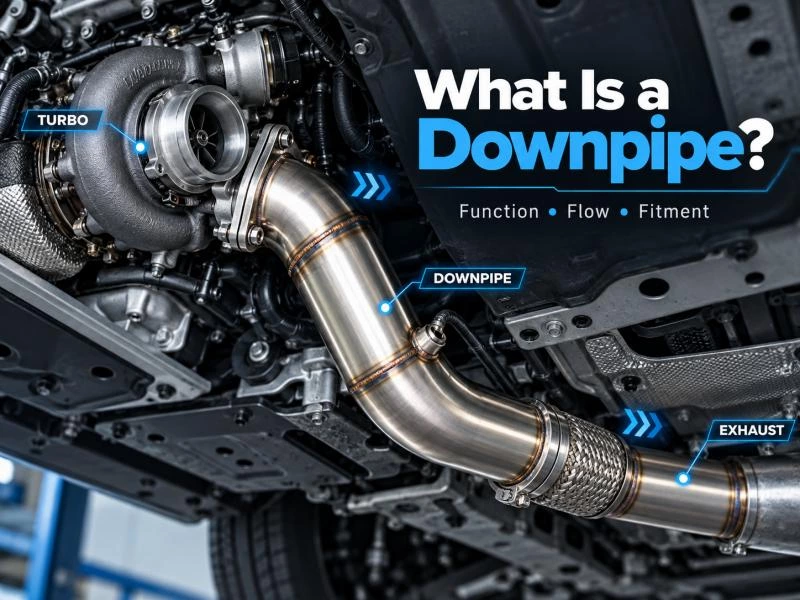
A downpipe is the exhaust pipe section that connects the outlet of a turbocharger to the downstream exhaust system. Exhaust gases leave the engine, pass through the exhaust manifold and turbine side of the turbocharger, and then enter the downpipe before continuing toward the catalytic converter, mid-pipe, muffler, and tailpipe.
In many turbocharged vehicles, the downpipe is one of the first major exhaust components after the turbocharger. Depending on the vehicle design, the catalytic converter may be integrated into the downpipe or positioned shortly after it.
A simplified turbocharged exhaust path looks like this:
Engine → Exhaust Manifold → Turbocharger → Downpipe → Catalytic Converter / Mid-Pipe → Rear Exhaust → Tailpipe
The exact layout varies between vehicles. Some downpipes are short and compact because the turbocharger is positioned close to the firewall, while others extend farther underneath the vehicle before connecting to the next exhaust section.
What Is the Main Purpose of a Downpipe?
The primary purpose of a downpipe is to move exhaust gases away from the turbocharger and into the rest of the exhaust system. Because these gases exit the turbine at high temperature and velocity, the downpipe needs to provide a durable and properly routed flow path.
A well-designed downpipe needs to balance several requirements:
- Carry exhaust gases efficiently away from the turbocharger
- Match the turbocharger outlet and downstream exhaust connection
- Maintain sufficient clearance from surrounding vehicle components
- Support oxygen sensor and catalytic converter requirements where applicable
- Withstand repeated high-temperature operating cycles
- Maintain reliable fitment under vibration and vehicle movement
For this reason, two downpipes with similar overall lengths may still be completely different products if their flange positions, bend angles, sensor locations, diameters, or vehicle applications are different.
Where Is the Downpipe Located?
The downpipe is located immediately downstream of the turbocharger. In most turbocharged vehicles, it begins at or near the turbine outlet and travels downward through the engine bay toward the underside of the vehicle.
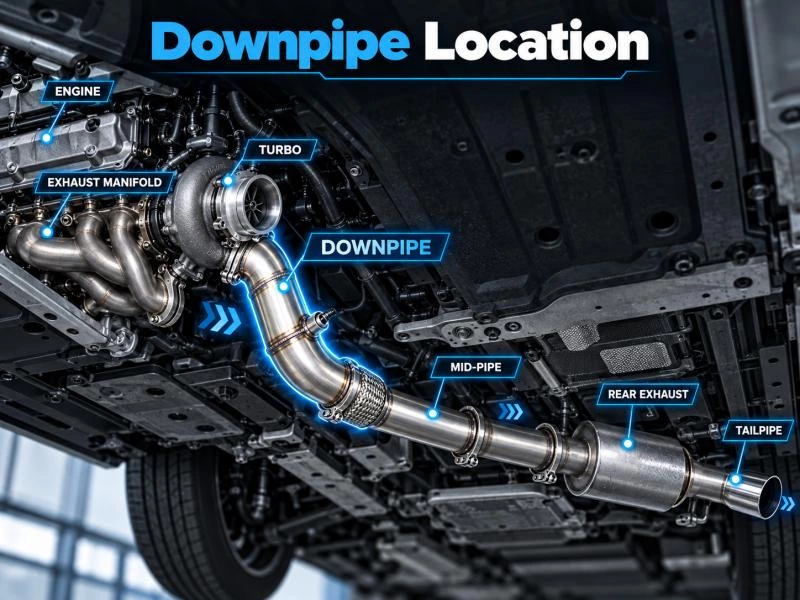
Its position explains the name “downpipe”: the pipe typically routes exhaust gases downward from the turbocharger before connecting to the lower sections of the exhaust system.
| Component | Typical Position | Main Function |
|---|---|---|
| Exhaust Manifold | Between engine and turbocharger | Collects exhaust gases from the engine |
| Turbocharger | After exhaust manifold | Uses exhaust energy to drive the turbine |
| Downpipe | Directly after turbocharger | Carries gases from the turbo into the exhaust system |
| Mid-Pipe | Under the vehicle | Connects front and rear exhaust sections |
| Rear Exhaust | Toward the rear of the vehicle | Controls sound and directs gases toward the outlet |
Why the Downpipe Location Matters
The downpipe operates in one of the hottest areas of the exhaust system because it receives gases immediately after they pass through the turbocharger. This means material selection, weld quality, flange design, and thermal durability are especially important.
Space is also limited in the engine bay. The pipe may need to route around the firewall, transmission, steering components, heat shields, or other nearby structures. Even small differences in bend position or flange angle can create fitment problems.
For vehicle-specific downpipes, manufacturers therefore need to consider the complete geometry of the component rather than only its diameter. Pipe size, bend radius, flange orientation, sensor ports, and downstream connection all need to work together.
Is a Downpipe the Same as an Exhaust Pipe?
A downpipe is a type of exhaust pipe, but the terms are not exactly interchangeable. Exhaust pipe is a broad term describing the tubing used throughout the exhaust system, while downpipe refers specifically to the section located after the turbocharger.
| Feature | Downpipe | General Exhaust Pipe |
|---|---|---|
| Location | Directly after the turbocharger | Can be used throughout the exhaust system |
| Vehicle Type | Mainly turbocharged applications | Turbocharged and naturally aspirated vehicles |
| Operating Environment | Very high thermal load near the turbo | Varies according to exhaust location |
| Design Requirements | Turbo flange, sensors, catalyst, bends and fitment | Diameter, routing, joints, hangers and fitment |
Both components still depend on accurate dimensions and suitable pipe sizing. If you want to understand how exhaust tubing size affects flow and system design, see our exhaust pipe diameter guide.
What Does a Downpipe Do?
A downpipe carries exhaust gases away from the turbocharger and into the rest of the exhaust system. Because it is positioned directly after the turbine outlet, it plays an important role in how easily those gases can continue downstream.
Its job is not simply to “make more power.” A downpipe mainly provides the transition between the turbocharger and the remaining exhaust system, while its diameter, bend geometry, catalytic converter design, and internal restriction can influence exhaust flow and turbo response.
The main functions of a downpipe include:
- Carrying hot exhaust gases away from the turbocharger
- Connecting the turbo outlet to the downstream exhaust system
- Providing mounting points for sensors where required
- Supporting catalytic converter integration on applicable vehicles
- Maintaining correct routing and clearance in the engine bay
- Managing exhaust flow through the first major pipe section after the turbo
How a Downpipe Affects Exhaust Flow
Exhaust gases leaving the turbocharger need to move through the downpipe before reaching the rest of the exhaust system. If the pipe contains restrictive bends, abrupt diameter changes, or a high-flow-resistance catalyst, the pressure downstream of the turbine can increase.
A smoother flow path can reduce unnecessary restriction, but the correct downpipe design still depends on the complete exhaust system. Increasing pipe diameter without considering the turbocharger outlet, engine output, downstream pipe size, and available installation space does not automatically improve performance.
This is why downpipe diameter should be selected as part of the complete exhaust design rather than treated as an isolated specification. For more detail on pipe sizing, see our exhaust pipe diameter guide.
How a Downpipe Can Affect Turbo Response
The turbocharger turbine is driven by exhaust gas energy. After passing through the turbine, the gases must leave efficiently through the downpipe.
Reducing unnecessary restriction after the turbine can improve the pressure difference across the turbocharger in some applications. This can influence how quickly the turbo responds, especially when the original downpipe or catalytic section is relatively restrictive.
However, the actual effect varies by vehicle. Turbo size, engine calibration, catalyst design, exhaust diameter, and the rest of the system all influence the final result.
How a Downpipe Affects Exhaust Sound
A downpipe can also change exhaust sound because it affects one of the first sections through which gases pass after the turbocharger.
Changes in pipe diameter, catalyst design, wall thickness, and downstream exhaust components can alter:
- Overall exhaust volume
- Turbo spool sound
- Low-frequency exhaust tone
- Sound under acceleration
The downpipe is only one part of the system, so final sound also depends on the mid-pipe, resonator, muffler, tailpipe, and overall pipe layout.
How Does a Downpipe Work?
A downpipe works by receiving exhaust gases directly from the turbocharger outlet and directing them into the next section of the exhaust system.
The process can be simplified as:
Engine Combustion → Exhaust Manifold → Turbocharger Turbine → Downpipe → Mid-Pipe / Catalyst → Rear Exhaust → Tailpipe
Exhaust gases leave the cylinders and enter the exhaust manifold. From there, they pass through the turbine housing of the turbocharger. The energy in the gas drives the turbine wheel, which helps compress intake air on the compressor side of the turbo.
After leaving the turbine, the gases enter the downpipe. The downpipe then guides them away from the engine bay and toward the rest of the exhaust system.
Step 1: Exhaust Gas Leaves the Turbocharger
The downpipe begins at the turbocharger outlet. This area experiences high temperatures and strong exhaust pulses, which is why flange design, material quality, and weld strength are important.
Step 2: The Gas Travels Through the Downpipe
As the exhaust moves through the pipe, the internal diameter and bend geometry influence how smoothly it can travel downstream.
A vehicle-specific downpipe may need several bends to clear the engine, transmission, firewall, steering components, or chassis. These bends must be positioned accurately so the pipe fits without contacting nearby components.
Step 3: Sensors and Catalyst May Be Integrated
Depending on the vehicle, the downpipe may include oxygen sensor ports, temperature sensor locations, or an integrated catalytic converter.
These features are part of the complete downpipe design and must be positioned correctly. Incorrect sensor locations or flange orientation can create installation and engine-management problems even if the pipe itself has the correct diameter.
Step 4: The Downpipe Connects to the Rest of the Exhaust System
At its lower end, the downpipe connects to the next exhaust section through a flange, slip joint, clamp, or other vehicle-specific connection.
This connection needs to match the downstream pipe diameter and routing. A poorly matched transition can create fitment problems or additional restriction.
For replacement and custom exhaust systems, correct dimensions at both ends of the downpipe are therefore essential. AOSU supports OEM and custom exhaust pipe production based on vehicle specifications, drawings, samples, and connection requirements.
What Makes a Good Downpipe Design?
A good downpipe design balances flow, durability, fitment, and compatibility with the vehicle. Simply using the largest possible pipe is not enough.
| Design Factor | Why It Matters |
|---|---|
| Pipe Diameter | Affects exhaust flow and compatibility with the turbo and downstream system |
| Bend Geometry | Influences routing, clearance, and flow consistency |
| Material | Affects corrosion resistance, heat durability, and service life |
| Flange Position | Ensures correct connection with the turbocharger and exhaust system |
| Sensor Ports | Must match vehicle-specific engine-management requirements |
| Catalyst Configuration | Affects emissions performance, restriction, and legality |
| Vehicle Clearance | Prevents contact with nearby components |
Material selection is especially important because the downpipe operates close to the turbocharger. Stainless steel is commonly used where heat resistance and corrosion resistance are important. For a broader comparison of exhaust materials, see our stainless steel exhaust pipe guide.
Stock Downpipe vs Aftermarket Downpipe
A stock downpipe is designed as part of the original vehicle exhaust system, with priorities such as emissions compliance, noise control, durability, packaging, manufacturing cost, and compatibility with the factory engine calibration.
An aftermarket downpipe may use a different pipe diameter, smoother bends, stainless steel construction, or a different catalytic converter configuration. Depending on the vehicle and application, these changes can reduce restriction or provide a different exhaust layout.
| Feature | Stock Downpipe | Aftermarket Downpipe |
|---|---|---|
| Main Design Goal | Factory emissions, NVH, durability and packaging | Flow, material, sound or application-specific requirements |
| Pipe Diameter | Matched to factory specifications | May use a larger or revised diameter |
| Routing | Designed around factory packaging | May use revised bends or transitions |
| Material | Depends on OEM specification | Often stainless steel |
| Catalytic Converter | Designed to meet factory emissions requirements | May use an alternative catalyst configuration |
| Fitment | Factory matched | Must be selected for the correct vehicle and engine |
Is a Larger Aftermarket Downpipe Always Better?
No. Increasing the downpipe diameter can reduce restriction in some applications, but the largest available pipe is not automatically the best choice.
The downpipe needs to work with the turbocharger outlet, engine output, catalytic converter, downstream exhaust diameter, available chassis space, and vehicle calibration. An oversized or poorly matched pipe can create unnecessary fitment problems without delivering a meaningful benefit.
Downpipe selection should be based on the complete exhaust system, not diameter alone.
For a broader explanation of how pipe dimensions affect an exhaust system, see our exhaust pipe diameter guide.
Vehicle-Specific Fitment Matters
Aftermarket downpipes are usually designed for specific engines and vehicle platforms because the turbo outlet, flange angle, sensor position, bends, mounting points, and downstream connection can differ significantly between models.
For example, a downpipe developed for a Toyota Hilux application cannot be assumed to fit another vehicle simply because the pipe diameter is similar. The complete geometry must match the vehicle.
AOSU supplies vehicle-specific exhaust products for applications including Toyota, Ford, Isuzu, Mitsubishi and other automotive platforms, with custom development available for OEM projects.
Catted vs Catless Downpipe: What Is the Difference?
One of the most common ways downpipes are classified is by whether a catalytic converter is incorporated into the pipe section.
A catted downpipe includes a catalytic converter, while a catless downpipe does not contain a catalyst in that section.
| Feature | Catted Downpipe | Catless Downpipe |
|---|---|---|
| Catalytic Converter | Included | Not included in the downpipe section |
| Exhaust Restriction | Depends on catalyst design | Generally lower through that section |
| Emissions Control | Designed to reduce regulated exhaust pollutants | Does not provide catalytic treatment in that section |
| Sound | Generally more controlled | May produce a louder or more aggressive exhaust note |
| Road Use | Depends on catalyst certification and local regulations | May not be legal for road use where emissions equipment is required |
What Is a High-Flow Catted Downpipe?
A high-flow catted downpipe uses a catalytic converter designed to provide emissions treatment while reducing some of the restriction associated with certain original exhaust configurations.
The actual flow characteristics depend on catalyst construction, cell density, pipe diameter, transition design, and vehicle application. A high-flow catalyst should therefore not be judged by pipe diameter alone.
Are Catless Downpipes Legal?
Road-use regulations vary by country and region. In markets where the vehicle is required to retain emissions-control equipment, removing or bypassing the catalytic converter may violate applicable regulations.
Before replacing a factory downpipe, vehicle owners and buyers should confirm local emissions requirements and whether the replacement component is approved for the intended application.
For road vehicles: Always confirm local emissions laws before changing the catalytic converter configuration.
Does a Downpipe Increase Performance?
A downpipe can influence vehicle performance, particularly on turbocharged engines, but it does not automatically produce a fixed horsepower increase.
The main reason a different downpipe may affect performance is that it can change exhaust restriction immediately after the turbocharger. If the original downpipe or catalytic section is relatively restrictive, a better-matched flow path may reduce downstream resistance and allow the turbocharger to operate more efficiently.
The actual result depends on several factors:
- Turbocharger design and size
- Engine displacement and output
- Original downpipe restriction
- Downpipe diameter
- Catalytic converter design
- Downstream exhaust system
- Engine management and calibration
Can a Downpipe Improve Turbo Response?
In some turbocharged applications, reducing unnecessary restriction after the turbine can improve the pressure difference across the turbocharger. This may help the turbo respond more quickly under certain operating conditions.
However, the effect varies from one vehicle to another. A downpipe should therefore be evaluated as part of the complete engine and exhaust configuration rather than treated as an isolated performance component.
Does a Downpipe Add Horsepower?
A less restrictive downpipe can support higher engine output when the original component limits exhaust flow, but there is no universal horsepower figure that applies to every vehicle.
A stock turbocharged engine with a relatively efficient factory downpipe may show a smaller change than an engine where the original exhaust section creates substantial restriction. Engine calibration and other supporting modifications can also influence the result.
Key point: A downpipe does not create horsepower by itself. It changes part of the exhaust flow path, and the final result depends on the complete engine, turbocharger, exhaust system and calibration.
Does a Downpipe Make the Car Louder?
It can. Changes to pipe diameter, catalytic converter design, wall thickness, and internal restriction can make turbo and exhaust sounds more noticeable.
A less restrictive downpipe may increase:
- Turbo spool sound
- Exhaust volume during acceleration
- Low-frequency exhaust tone
- Sound transmitted through the downstream exhaust system
However, overall sound still depends heavily on the rest of the exhaust system, including the mid-pipe, resonator, muffler, pipe diameter, and outlet design. For an overview of how these components work together, see our complete guide to automotive exhaust systems.
Do You Need a Tune After Installing a Downpipe?
Whether engine calibration is required depends on the vehicle, downpipe design, catalyst configuration, sensor arrangement, and engine-management strategy.
Some vehicles may operate with a compatible replacement downpipe without calibration changes, while others may require appropriate tuning when exhaust flow or catalyst configuration is significantly altered.
The correct approach should follow the requirements of the specific vehicle and engine-management system rather than assuming that every downpipe installation requires the same calibration.
Why Downpipe Diameter Matters
Downpipe diameter affects how exhaust gases move away from the turbocharger, but choosing the correct size is more important than simply choosing the largest pipe available.
A downpipe that is too restrictive may limit exhaust flow, while an oversized pipe can create unnecessary fitment challenges and may not provide additional benefit if the turbo outlet or downstream exhaust system remains smaller.
Downpipe diameter should be matched with:
- Turbocharger outlet size
- Engine displacement and power level
- Downstream exhaust pipe diameter
- Catalytic converter configuration
- Available chassis and engine-bay clearance
- Vehicle-specific fitment requirements
Why Bigger Is Not Always Better
A larger downpipe can increase available flow area, but the rest of the exhaust system must also be considered. If a large downpipe connects immediately to a much smaller pipe, the smaller downstream section can become the next restriction point.
Large diameter changes can also require different reducers, flanges, bends, or installation space. For this reason, diameter should be selected as part of the complete exhaust layout.
For more information about exhaust sizing, pipe diameter, and vehicle applications, see our exhaust pipe diameter guide.
Downpipe Diameter and Vehicle Fitment
Diameter also affects physical fitment. A larger pipe requires more clearance around the transmission, firewall, chassis, heat shields, and other nearby components.
On vehicle-specific downpipes, manufacturers must therefore balance internal flow area with external packaging requirements. Bend radius and pipe position may need to change as diameter increases.
| Diameter Factor | What It Affects |
|---|---|
| Turbo Outlet Size | Determines the initial connection requirement |
| Pipe Diameter | Influences flow area and installation space |
| Downstream Exhaust Size | Affects transition design and overall system balance |
| Bend Radius | Influences routing and clearance |
| Vehicle Packaging | Limits available pipe size and routing options |
What Materials Are Used for Downpipes?
Downpipes operate close to the turbocharger, where exhaust temperatures can be relatively high. Material selection therefore affects corrosion resistance, heat durability, weld quality, and service life.
Stainless steel is commonly used for replacement and aftermarket downpipes because it provides a practical combination of heat resistance, corrosion resistance, and manufacturing flexibility.
304 Stainless Steel Downpipe
304 stainless steel provides strong corrosion resistance and is commonly selected for applications where long-term surface durability is important.
Typical characteristics include:
- Good corrosion resistance
- Suitable weldability
- Good resistance to moisture and road contaminants
- Common use in premium aftermarket exhaust components
409 Stainless Steel Downpipe
409 stainless steel is widely used in automotive exhaust applications because it provides good high-temperature durability at a lower material cost than 304 stainless steel.
Its appearance may change over time because surface oxidation is more common than with 304 stainless steel, but this does not necessarily mean the material has structurally failed.
| Feature | 304 Stainless Steel | 409 Stainless Steel |
|---|---|---|
| Corrosion Resistance | Higher | Good for automotive exhaust use |
| Heat Resistance | Good | Good |
| Surface Appearance | Maintains appearance better | May develop surface oxidation |
| Cost | Higher | Generally lower |
| Typical Application | Premium aftermarket and custom systems | OEM and cost-sensitive automotive exhaust applications |
Material is only one part of downpipe quality. Wall thickness, weld consistency, flange material, bend accuracy, and surface condition are also important.
For a broader comparison of common exhaust materials, see our stainless steel exhaust pipe guide.
How to Choose the Right Downpipe
Choosing a downpipe should begin with vehicle compatibility rather than sound or pipe diameter alone. A correctly designed downpipe must match both the turbocharger connection and the downstream exhaust system.
Before purchasing or developing a replacement downpipe, check the following information:
- Vehicle make, model and year
Different vehicle generations may use different turbochargers, exhaust layouts, and mounting points. - Engine and turbocharger configuration
The turbo outlet and available installation space determine the upper connection geometry. - Downpipe diameter
Confirm compatibility with both the turbocharger and downstream exhaust system. - Flange design
Check bolt pattern, flange orientation, and connection angle. - Sensor positions
Oxygen sensors and other monitoring points must be positioned correctly for the vehicle application. - Catalyst requirement
Confirm whether the original system uses an integrated catalytic converter and whether local emissions regulations apply. - Lower exhaust connection
Verify whether the downpipe connects through a flange, clamp, slip joint, or another vehicle-specific design.
Check Fitment Before Ordering
Two downpipes may look similar but still have different flange angles, bend positions, sensor locations, or overall lengths. For this reason, vehicle model information alone is not always enough when developing a custom component.
For OEM or custom downpipe development, useful information includes:
- Vehicle make, model, year, and engine
- 2D or 3D drawing
- Physical sample
- Pipe diameter and wall thickness
- Flange and sensor specifications
- Material requirement
- Expected order quantity
If dimensions need to be confirmed from an existing component, our guide on how to measure an exhaust pipe explains how to check diameter, length, bends, connections, and fitment.
OEM and Custom Downpipe Applications
For OEM and vehicle-specific projects, downpipes can be developed according to drawings, samples, and application requirements rather than relying on universal fitment.
AOSU supports OEM and custom exhaust pipe production with vehicle-specific tube bending, welding, flange positioning, sensor-port integration, and dimensional inspection.
Current AOSU exhaust applications include vehicle platforms from Toyota, Ford, Mitsubishi, and other automotive brands, with custom development available according to project specifications.
Downpipe vs Cat-Back Exhaust: What Is the Difference?
A downpipe and a cat-back exhaust are both parts of the exhaust system, but they are located in different areas and serve different purposes.
| Feature | Downpipe | Cat-Back Exhaust |
|---|---|---|
| Location | Immediately after the turbocharger | From the catalytic converter rearward |
| Main Focus | Turbo outlet flow and front exhaust routing | Downstream flow, sound, and rear exhaust layout |
| Catalyst | May contain or connect directly to a catalyst | Typically starts after the catalyst |
| Sound Effect | Can influence turbo and exhaust tone | Usually has a stronger influence on overall exhaust sound |
| Vehicle Fitment | Highly dependent on turbo and engine layout | Dependent on underbody and rear exhaust layout |
Because these components affect different areas of the system, upgrading one does not automatically replace the function of the other. They should be considered as separate parts of the complete exhaust layout.
FAQ About Downpipes
What is a downpipe on a car?
A downpipe is the exhaust section located directly after the turbocharger. It carries exhaust gases away from the turbine outlet and connects the turbo to the downstream exhaust system.
What does a downpipe do?
A downpipe provides the flow path between the turbocharger and the rest of the exhaust system. Its diameter, bends, catalyst design, flange position, and sensor locations can influence exhaust restriction, turbo response, sound, and vehicle fitment.
Is a downpipe only used on turbocharged cars?
The term “downpipe” is most commonly used for turbocharged vehicles because it refers to the pipe immediately after the turbocharger. Naturally aspirated vehicles also have front exhaust pipes, but these sections are not usually described as turbo downpipes.
Does a downpipe make a car louder?
It can. Changes in pipe diameter, catalytic converter design, wall thickness, and internal restriction may make turbo and exhaust sounds more noticeable. However, overall sound also depends on the mid-pipe, resonator, muffler, rear exhaust, and outlet design.
Does a downpipe increase horsepower?
A less restrictive downpipe can support improved exhaust flow on some turbocharged engines, especially when the factory section creates significant restriction. However, there is no fixed horsepower increase that applies to every vehicle. Results depend on the turbocharger, engine, catalyst, downstream exhaust, and engine calibration.
What size downpipe do I need?
The correct downpipe size depends on the turbo outlet, engine output, downstream exhaust diameter, available installation space, and vehicle application. Choosing the largest possible diameter is not always the best solution.
For more detail about exhaust sizing, see our exhaust pipe diameter guide.
What is the difference between a catted and catless downpipe?
A catted downpipe includes a catalytic converter in the downpipe section, while a catless downpipe does not. Catted designs provide emissions treatment, while catless designs remove that catalyst from the section and may not be legal for road use where emissions equipment is required.
Do I need a tune after installing a downpipe?
It depends on the vehicle and downpipe configuration. Some replacement downpipes may work with the existing engine-management strategy, while significant changes to exhaust flow, catalyst configuration, or sensor behavior may require appropriate calibration.
How do I know if a downpipe will fit my vehicle?
Check the vehicle make, model, year, engine, turbocharger outlet, pipe diameter, flange design, sensor positions, catalyst configuration, and downstream connection. For custom development, drawings or a physical sample can provide more accurate fitment information.
What material is best for a downpipe?
Stainless steel is commonly used because it offers good heat resistance, corrosion resistance, and weldability. 304 stainless steel provides higher corrosion resistance, while 409 stainless steel is widely used in automotive exhaust applications because of its balance of durability and cost.
For a broader comparison, see our stainless steel exhaust pipe guide.
Conclusion
A downpipe is the exhaust section that connects the turbocharger to the rest of the exhaust system. Although its basic function is simple, the design of a downpipe involves much more than using a larger tube.
Pipe diameter, bend geometry, catalyst configuration, material, flange position, sensor locations, and vehicle clearance all influence how the component performs and fits. A properly designed downpipe should provide a suitable exhaust path while maintaining compatibility with the turbocharger, downstream exhaust system, and vehicle layout.
Aftermarket downpipes can change exhaust flow, turbo response, and sound, but the actual result varies by vehicle. Larger diameter, catless construction, or reduced restriction should not automatically be treated as better choices without considering engine requirements, emissions regulations, and overall exhaust-system compatibility.
For replacement, OEM, and custom projects, accurate vehicle information and dimensions are essential. AOSU provides OEM and custom exhaust pipe solutions for different automotive applications, including vehicle-specific downpipes developed from drawings, samples, and project requirements.
If you need a custom downpipe or vehicle-specific exhaust pipe, contact AOSU with your vehicle details, drawings, sample, material requirements, and expected order quantity for further evaluation.