Exhaust Pipe Wall Thickness: 1.2mm vs 1.5mm vs 2.0mm
Exhaust pipe wall thickness affects much more than the amount of metal used in the tube. It can influence pipe weight, stiffness, bending behavior, welding requirements, vibration resistance, internal diameter, and the overall durability of an exhaust system.
For automotive exhaust tubing, common wall thicknesses include 1.2 mm, 1.5 mm, and 2.0 mm. However, a thicker pipe is not automatically better. The correct thickness depends on the pipe diameter, material grade, exhaust layout, number of bends, mounting points, vehicle application, and OEM design requirements.
It is also important to distinguish wall thickness from pipe diameter. Two exhaust pipes can have the same outside diameter but different wall thicknesses, which means they will have different internal diameters, weights, and structural characteristics.
Quick Answer: 1.2 mm exhaust tubing offers lower weight and uses less material, 1.5 mm provides a practical balance between weight and structural strength for many automotive applications, and 2.0 mm offers greater stiffness and material thickness where additional robustness is required. The best choice depends on the complete exhaust design rather than wall thickness alone.
For OEM and custom exhaust projects, wall thickness should be evaluated together with material, pipe diameter, bending geometry, welding process, hanger locations, and vehicle fitment.
What Is Exhaust Pipe Wall Thickness?
Exhaust pipe wall thickness is the distance between the outside surface and the inside surface of the tube. It determines how much material surrounds the exhaust passage and directly affects the pipe's internal diameter, weight, stiffness, bending behavior, and welding characteristics.
Wall thickness should not be confused with the outside diameter of the pipe. For example, two exhaust pipes may both have a 60 mm outside diameter but use different wall thicknesses such as 1.2 mm and 2.0 mm. The thicker pipe will have a smaller internal diameter and more material in the tube wall.
Basic Formula: Wall Thickness = (Outside Diameter − Inside Diameter) ÷ 2
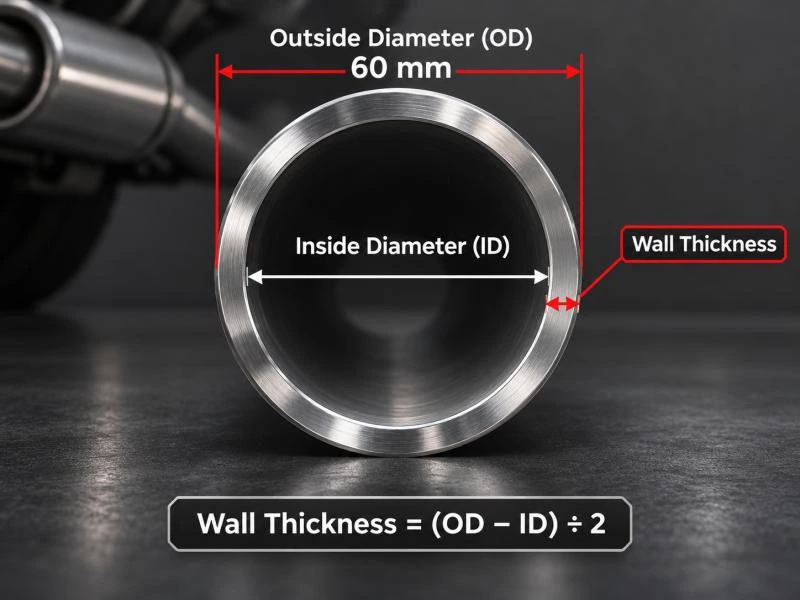
Outside Diameter vs Inside Diameter vs Wall Thickness
These three dimensions describe different parts of the same exhaust tube:
- Outside Diameter (OD): The total diameter measured across the outside of the pipe.
- Inside Diameter (ID): The open internal diameter available for exhaust gas flow.
- Wall Thickness: The thickness of the metal between the OD and ID.
For the same outside diameter, increasing wall thickness reduces the internal diameter. This slightly reduces the available internal cross-sectional area while increasing the amount of material, pipe weight, and structural stiffness.
| Outside Diameter | Wall Thickness | Approx. Inside Diameter |
|---|---|---|
| 60 mm | 1.2 mm | 57.6 mm |
| 60 mm | 1.5 mm | 57.0 mm |
| 60 mm | 2.0 mm | 56.0 mm |
This difference may appear small, but it becomes more important when wall thickness is considered together with pipe diameter, bends, exhaust length, and the overall flow requirements of the engine.
If you are selecting exhaust tubing, both diameter and wall thickness should be specified separately. Our exhaust pipe diameter guide explains how pipe size affects flow and exhaust behavior in more detail.
1.2mm vs 1.5mm vs 2.0mm Exhaust Pipe Wall Thickness
The main differences between 1.2 mm, 1.5 mm, and 2.0 mm exhaust tubing are related to weight, stiffness, forming behavior, welding requirements, and the amount of material used. None of these thicknesses is automatically the best choice for every exhaust system.
| Factor | 1.2 mm | 1.5 mm | 2.0 mm |
|---|---|---|---|
| Pipe Weight | Lowest | Moderate | Highest |
| Structural Stiffness | Lower | Balanced | Higher |
| Material Usage | Lowest | Moderate | Highest |
| Bending Control | More sensitive to deformation | Good balance for forming | Requires greater forming force |
| Welding | Requires careful heat control | Balanced welding characteristics | Requires more heat input |
| Typical Design Priority | Lower weight | Balance of weight and strength | Higher stiffness and robustness |
A thinner wall reduces pipe weight, but it also leaves less material to resist deformation during bending and welding. A thicker wall provides greater stiffness, but it increases weight, material consumption, and forming load.
For many automotive exhaust applications, 1.5 mm tubing provides a practical middle ground between these two extremes. However, the final specification should still depend on pipe diameter, stainless steel grade, bend geometry, hanger positions, vibration conditions, and vehicle-specific requirements.
Key Point: Wall thickness should not be selected by thickness alone. A 1.5 mm tube may be suitable for one exhaust design while another application may require a thinner or thicker wall because of different materials, pipe diameters, bends, mounting conditions, or durability targets.
1.2mm Exhaust Pipe: Lightweight and Material-Efficient
A 1.2 mm exhaust pipe wall uses less material than 1.5 mm or 2.0 mm tubing of the same diameter. This reduces the weight of the exhaust system and can be useful where lightweight construction is an important design objective.
However, thinner tubing requires better control during manufacturing. Because there is less material in the wall, excessive bending force or welding heat can cause distortion more easily than with thicker tubing.
Advantages of 1.2mm Exhaust Tubing
- Lower pipe weight
- Reduced material consumption
- Suitable for applications where weight reduction is important
- Can provide adequate strength when the material, diameter, and exhaust layout are properly designed
What Should Be Considered with 1.2mm Tubing?
Manufacturing control becomes especially important when thinner tubing includes tight bends, multiple welded joints, or long unsupported sections.
Important factors include:
- Bend radius and tooling
- Ovality during tube bending
- Wall thinning on the outside of bends
- Welding heat input
- Hanger and support locations
- Vibration during vehicle operation
A 1.2 mm wall should therefore not be selected only because it is lighter. The complete exhaust structure must still provide sufficient durability for the intended vehicle and operating environment.
1.5mm Exhaust Pipe: A Balance of Weight and Durability
1.5 mm exhaust tubing provides more material and stiffness than a 1.2 mm wall while remaining significantly lighter than thicker 2.0 mm tubing of the same diameter.
This balance makes 1.5 mm a practical option for many automotive exhaust designs, particularly where the pipe must withstand bending, welding, vibration, and repeated thermal cycles without adding unnecessary weight.
Why Is 1.5mm Common in Automotive Exhaust Systems?
A 1.5 mm wall offers a useful compromise between several competing design requirements:
- Enough material for controlled tube bending
- Good stiffness without excessive pipe weight
- Practical welding characteristics
- Suitable durability for many vehicle-specific exhaust layouts
- Reasonable material consumption for production applications
However, 1.5 mm should not be treated as a universal standard. A short straight section, a complex bent pipe, a large-diameter tube, and a long rear exhaust section can all place different demands on the material.
Practical Selection: 1.5 mm is often chosen when designers need a balance between weight, stiffness, manufacturing stability, and durability, but the final specification should still follow the requirements of the complete exhaust system.
2.0mm Exhaust Pipe: Greater Stiffness and Robustness
A 2.0 mm exhaust pipe wall contains substantially more material than 1.2 mm or 1.5 mm tubing of the same outside diameter. This increases the stiffness and mass of the pipe and can be useful where additional structural robustness is required.
The thicker wall can provide more resistance to denting and local deformation, but it also increases overall exhaust weight and places greater demands on bending equipment and manufacturing processes.
Advantages of 2.0mm Exhaust Tubing
- Higher structural stiffness
- Greater resistance to local deformation
- More material around welded joints
- Potentially useful for applications with higher structural loads or demanding packaging conditions
Trade-Offs of a Thicker Wall
More material is not automatically an advantage. Moving from 1.5 mm to 2.0 mm increases pipe weight, material cost, and forming load.
A thicker wall can also reduce the internal diameter when the outside diameter remains unchanged. This means that wall thickness should be considered together with the required exhaust flow area rather than evaluated only from a strength perspective.
For this reason, 2.0 mm tubing should normally be specified because the application requires additional stiffness or durability, not simply because a thicker pipe appears more robust.
Which Is Better: 1.2mm, 1.5mm or 2.0mm?
There is no single best exhaust pipe wall thickness. Each option represents a different balance between weight, stiffness, manufacturability, and durability.
In simplified terms:
- 1.2 mm: prioritizes lower weight and material efficiency.
- 1.5 mm: offers a balanced solution for many automotive exhaust designs.
- 2.0 mm: provides greater stiffness where additional structural robustness is required.
The correct choice should ultimately be based on material grade, pipe diameter, bend geometry, exhaust length, mounting points, vehicle packaging, vibration conditions, and the requirements specified in the OEM drawing or development project.
How Wall Thickness Changes Exhaust Pipe Weight
Wall thickness has a direct effect on exhaust pipe weight. If the outside diameter, material, and pipe length remain the same, a thicker wall means more metal is used in every section of the tube.
For example, consider three exhaust pipes with the same 60 mm outside diameter:
| Wall Thickness | Approx. Inside Diameter | Relative Material per Meter |
|---|---|---|
| 1.2 mm | 57.6 mm | Baseline |
| 1.5 mm | 57.0 mm | About 24% more than 1.2 mm |
| 2.0 mm | 56.0 mm | About 64% more than 1.2 mm |
These percentages are theoretical comparisons of tube-wall cross-sectional area. Actual pipe weight also depends on material density, dimensional tolerance, weld seam construction, and the finished component design.
The difference becomes more significant across a complete exhaust system. Long pipe sections, multiple branches, mufflers, flanges, and other components can make small increases in tubing weight add up quickly.
For this reason, specifying a thicker wall than necessary can increase total system mass without providing a meaningful benefit for the intended application.
Key Point: Increasing wall thickness improves stiffness but also adds weight. Exhaust tubing should therefore be thick enough for the required durability without adding unnecessary material.
Does Exhaust Pipe Wall Thickness Affect Exhaust Flow?
Wall thickness can affect exhaust flow because it changes the inside diameter of the pipe when the outside diameter remains the same.
For example, a 60 mm OD tube with a 1.2 mm wall has an approximate inside diameter of 57.6 mm, while the same tube with a 2.0 mm wall has an inside diameter of approximately 56.0 mm.
Because exhaust gases flow through the internal cross-sectional area, the thicker tube provides slightly less open area when both pipes use the same outside diameter.
| 60 mm OD Pipe | Approx. ID | Approx. Internal Flow Area |
|---|---|---|
| 1.2 mm Wall | 57.6 mm | 2,606 mm² |
| 1.5 mm Wall | 57.0 mm | 2,552 mm² |
| 2.0 mm Wall | 56.0 mm | 2,463 mm² |
The difference is relatively small in this example, so wall thickness should not be treated as the main factor controlling exhaust flow. Overall pipe diameter, bends, transitions, mufflers, catalytic components, and the complete exhaust layout usually have a greater influence.
This is also why comparing exhaust pipes only by outside diameter can be misleading. For engineering or OEM specifications, both OD and wall thickness should be confirmed.
For a more detailed explanation of pipe size and exhaust flow, see our exhaust pipe diameter guide.
How Wall Thickness Affects Exhaust Pipe Bending
Wall thickness plays an important role during tube bending. When an exhaust pipe is bent, the material on the outside of the bend is stretched while the material on the inside is compressed.
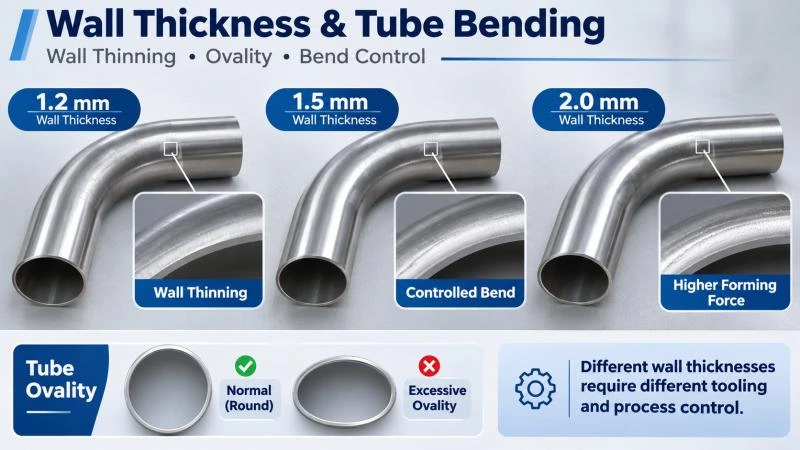
If this deformation is not properly controlled, the finished bend can develop:
- Excessive wall thinning on the outside radius
- Wrinkling on the inside radius
- Flattening or ovality
- Reduction in internal cross-sectional area
- Dimensional variation that affects vehicle fitment
Bending 1.2mm Tubing
Thinner 1.2 mm tubing is lighter, but it can be more sensitive to deformation during tight-radius bending. Tooling, mandrel support, clamping pressure, lubrication, and bend speed need to be properly controlled to maintain the tube shape.
Poor process control can cause the outside wall to become excessively thin or the pipe cross-section to flatten.
Bending 1.5mm Tubing
A 1.5 mm wall provides additional material to resist deformation while still maintaining a practical weight. This can provide a useful balance for vehicle-specific exhaust pipes containing multiple bends and welded sections.
However, bend quality still depends on diameter, bend radius, material grade, tooling, and the bending process rather than wall thickness alone.
Bending 2.0mm Tubing
A 2.0 mm wall provides greater resistance to local deformation, but the thicker material requires greater forming force. Equipment capacity and tooling therefore become more important, particularly with larger tube diameters or tight bend radii.
Important: Thicker tubing is not automatically easier to bend. Every combination of diameter, wall thickness, material, and bend radius requires suitable tooling and process settings.
How Wall Thickness Affects Exhaust Pipe Welding
Wall thickness also influences how an exhaust pipe responds to welding. Heat input must be controlled according to the amount of material around the joint.
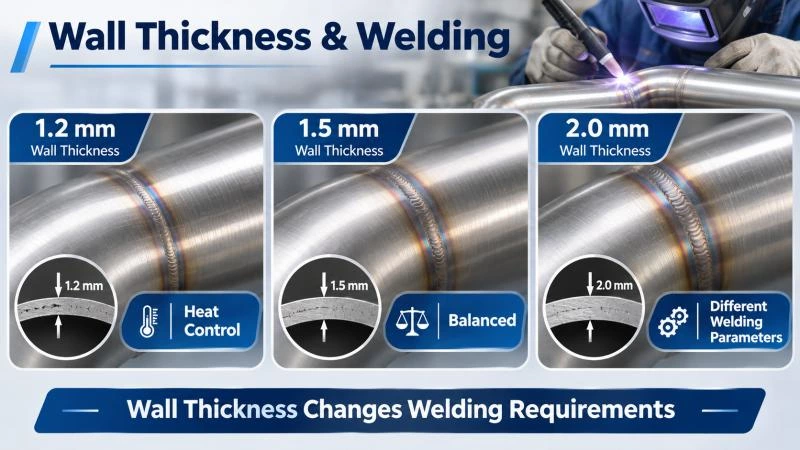
Thin-Wall Exhaust Tubing
With thinner tubing such as 1.2 mm, excessive heat can more easily cause burn-through, distortion, or a wider heat-affected area. Consistent joint fit-up and controlled welding parameters become especially important.
Thin tubing can be welded reliably, but the process needs to limit unnecessary heat while still achieving complete and consistent joining.
Medium-Wall Exhaust Tubing
A 1.5 mm wall generally provides more tolerance during welding than a thinner tube while remaining suitable for lightweight automotive exhaust construction. It provides additional material around the weld joint without adding as much weight as 2.0 mm tubing.
Thicker Exhaust Tubing
A 2.0 mm wall can tolerate more welding heat before burn-through becomes a concern, but the additional material also requires sufficient heat input to achieve a sound joint.
Using welding parameters intended for thinner tubing may result in inadequate fusion, while excessive heat can still create distortion or affect surrounding components.
Regardless of wall thickness, exhaust weld quality depends on several factors:
- Material grade
- Joint design and fit-up
- Tube wall thickness
- Welding process and parameters
- Shielding and surface preparation
- Production consistency
For exhaust pipes containing multiple welded sections, bends, flanges, or branch connections, wall thickness should therefore be considered during both component design and welding process development.
If you want to compare different joining methods, see our guide to joining exhaust pipes.
Material Matters Too: 304 vs 409 Stainless Steel
Wall thickness should never be evaluated separately from the exhaust pipe material. Two pipes with the same 1.5 mm wall thickness can behave differently if one is made from 304 stainless steel and the other from 409 stainless steel.
Material grade affects corrosion resistance, strength, forming behavior, welding characteristics, cost, and long-term appearance. This means that specifying only the wall thickness is not enough for an OEM or custom exhaust project.
For example, a project using 1.5 mm 304 stainless steel may prioritize corrosion resistance and long-term surface durability, while 1.5 mm 409 stainless steel may be selected where automotive durability and cost balance are more important.
| Factor | 304 Stainless Steel | 409 Stainless Steel |
|---|---|---|
| Corrosion Resistance | Higher | Suitable for many automotive exhaust applications |
| Surface Appearance | Generally retains appearance better | More likely to show surface oxidation |
| Cost | Higher | Generally lower |
| Typical Priority | Corrosion resistance and appearance | Automotive durability and cost balance |
This is why statements such as “1.5 mm is better than 1.2 mm” can be misleading without knowing the material and application. Wall thickness, material grade, diameter, and exhaust design should be considered together.
For a more detailed comparison of automotive stainless steel grades, see our stainless steel exhaust pipe guide.
How to Choose the Right Exhaust Pipe Wall Thickness
Choosing the right exhaust pipe wall thickness involves balancing weight, structural requirements, manufacturing processes, durability, and vehicle fitment. Simply selecting the thickest available tubing can add unnecessary weight and material cost without improving the exhaust system in a meaningful way.
Before deciding between 1.2 mm, 1.5 mm, and 2.0 mm tubing, consider the following factors.
1. Pipe Material
Different stainless steel grades have different mechanical, corrosion, and manufacturing characteristics. Wall thickness should therefore be selected together with the specified material rather than treated as an independent dimension.
2. Pipe Diameter
Larger-diameter tubing can behave differently during bending and vibration than smaller tubing using the same wall thickness. Diameter also determines the internal flow area available after wall thickness is taken into account.
For OEM specifications, both outside diameter and wall thickness should always be confirmed.
3. Bend Geometry
Exhaust pipes with tight bends or complex routing place greater demands on the tube during forming. Bend radius, tooling, mandrel support, and material properties all affect how well the pipe maintains its cross-section.
A thinner wall may require more careful forming control, while a thicker wall requires greater bending force.
4. Welding Requirements
Exhaust assemblies containing multiple flanges, branches, hangers, or welded pipe sections need a wall thickness compatible with the welding process.
Thin tubing requires tighter heat control, while thicker tubing may require greater heat input to achieve reliable fusion.
5. Hanger Positions and Unsupported Length
The way an exhaust system is supported also influences the required stiffness. Long unsupported pipe sections may experience greater vibration and bending loads than short sections supported by properly positioned hangers.
Wall thickness should therefore be considered together with the complete hanger layout rather than selected only from the pipe dimensions.
6. Vehicle Operating Conditions
Passenger cars, SUVs, pickup trucks, performance vehicles, and other automotive applications can experience different vibration, road, temperature, and packaging conditions.
However, vehicle category alone should not determine wall thickness. A pickup truck does not automatically require 2.0 mm tubing, just as a passenger car does not automatically require 1.2 mm tubing.
7. Weight Target
Reducing tubing thickness can lower the mass of the complete exhaust system, particularly where long pipe sections are used. This can be important in applications where overall vehicle weight is closely controlled.
Weight reduction should still be balanced against bending quality, welding requirements, stiffness, and expected durability.
8. OEM Drawing or Project Specification
For replacement and OEM exhaust components, the original engineering specification should normally take priority. Wall thickness may already have been selected according to durability testing, vehicle vibration, packaging, manufacturing, and cost targets.
Selection Principle: Choose exhaust pipe wall thickness as part of the complete system design. Material, OD, bends, welds, hanger positions, vehicle packaging, vibration, durability, and weight targets all matter.
Simple 1.2mm vs 1.5mm vs 2.0mm Selection Guide
| If Your Main Priority Is... | Wall Thickness Direction |
|---|---|
| Reducing tubing weight | Consider thinner-wall options such as 1.2 mm where the design allows |
| Balancing weight, stiffness and manufacturability | 1.5 mm can be a practical starting point for many automotive designs |
| Increasing structural stiffness | Consider thicker options such as 2.0 mm when supported by the application |
| Matching an OEM replacement component | Follow the original drawing or verified sample specification |
These are selection directions rather than universal specifications. The final wall thickness should be verified against the actual exhaust design and production requirements.
OEM and Custom Exhaust Pipe Wall Thickness
For OEM and custom exhaust projects, wall thickness is normally specified together with material grade, pipe diameter, bend geometry, connection points, and vehicle fitment requirements.
A wall thickness that works well for one exhaust system may not be suitable for another, even when both use the same stainless steel grade. Differences in pipe diameter, unsupported length, bend radius, hanger positions, engine vibration, and vehicle packaging can change the structural demands placed on the tubing.
For this reason, custom exhaust development should begin with complete project information rather than selecting wall thickness as an isolated number.
Information Needed for Custom Exhaust Pipe Development
- Vehicle make, model, year, and engine
- Required stainless steel grade
- Outside diameter and wall thickness
- Overall pipe length
- Bend angles and bend radius
- Flange and connection dimensions
- Hanger locations
- Existing drawing or physical sample
- Expected production quantity
When an original exhaust pipe is available, dimensions and wall thickness can be checked from the sample. For new OEM projects, drawings and engineering specifications should define the required tubing dimensions before prototype production begins.
AOSU provides OEM and custom exhaust pipe manufacturing based on vehicle information, technical drawings, samples, materials, and project requirements.
Frequently Asked Questions About Exhaust Pipe Wall Thickness
What is the standard wall thickness for an exhaust pipe?
There is no single standard wall thickness for every automotive exhaust pipe. Common options include 1.2 mm, 1.5 mm, and 2.0 mm, but the correct specification depends on material, pipe diameter, exhaust design, manufacturing process, vehicle application, and OEM requirements.
Is 1.5mm thick enough for an exhaust pipe?
Yes, 1.5 mm tubing can be suitable for many automotive exhaust applications when the material, pipe diameter, bends, welding, and support layout are correctly designed. However, it should not be treated as a universal specification for every vehicle or exhaust system.
Is 2.0mm exhaust pipe better than 1.5mm?
Not necessarily. A 2.0 mm wall provides more material and greater stiffness, but it also adds weight, material cost, and forming load. If the application does not require the additional stiffness, 1.5 mm may provide a more efficient balance.
Does a thicker exhaust pipe last longer?
Additional wall thickness can provide more material to resist local deformation and wear, but service life also depends on stainless steel grade, corrosion exposure, welding quality, vibration, thermal cycling, hanger design, and vehicle operating conditions.
A poorly designed 2.0 mm pipe is not automatically more durable than a properly designed 1.5 mm pipe.
Does exhaust pipe wall thickness affect sound?
Wall thickness can influence the vibration and acoustic characteristics of the pipe, but it is only one part of exhaust sound. Pipe diameter, length, muffler design, resonators, outlet configuration, engine characteristics, and vehicle structure usually have a greater influence on the final exhaust note and cabin noise.
Does wall thickness affect exhaust flow?
Yes, if the outside diameter remains the same. A thicker wall reduces the inside diameter and therefore slightly reduces the available internal flow area.
However, wall thickness should not be treated as the main exhaust flow variable. Overall pipe diameter and the complete exhaust system design usually have a greater effect.
How do you measure exhaust pipe wall thickness?
Wall thickness can be determined from the difference between outside diameter and inside diameter using the formula:
Wall Thickness = (Outside Diameter − Inside Diameter) ÷ 2
For greater accuracy, wall thickness can also be measured directly using suitable measuring equipment when the tube edge is accessible.
Should I choose exhaust pipe thickness by vehicle type?
Vehicle type can influence the design, but it should not be the only selection factor. A passenger car does not automatically require thin tubing, and a pickup truck does not automatically require 2.0 mm tubing.
Material, pipe diameter, exhaust routing, vibration, hanger positions, operating environment, and original engineering requirements should all be considered.
Conclusion
Exhaust pipe wall thickness affects weight, stiffness, bending behavior, welding requirements, internal diameter, and overall durability. The differences between 1.2 mm, 1.5 mm, and 2.0 mm therefore involve much more than simply choosing a thicker or thinner tube.
A 1.2 mm wall can help reduce weight and material use, 1.5 mm provides a practical balance for many automotive exhaust designs, and 2.0 mm offers greater stiffness where the application requires additional structural robustness.
However, no wall thickness is universally better. The correct specification should be selected together with pipe diameter, material grade, bends, welding, hanger locations, vehicle packaging, vibration conditions, and OEM requirements.
Final Takeaway: Choose exhaust pipe wall thickness as part of the complete exhaust system design, not as an isolated specification. The goal is to achieve sufficient durability and manufacturing stability without adding unnecessary weight or material.
For OEM or custom exhaust pipe development, AOSU can manufacture vehicle-specific exhaust components based on drawings, samples, materials, pipe dimensions, and project requirements.
If you need help with an exhaust pipe project, contact AOSU with your vehicle information, drawing or sample, material specification, pipe diameter, wall thickness, and expected order quantity.