Cat-Back vs Axle-Back Exhaust: What’s the Difference?
When choosing an exhaust upgrade, two terms appear frequently: cat-back exhaust and axle-back exhaust. Both replace sections of the exhaust system behind the engine, but they differ significantly in how much piping is replaced, how they affect exhaust sound and flow, and how much installation work is involved.
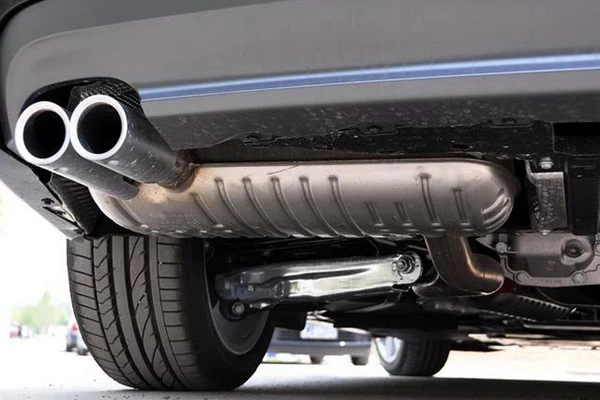
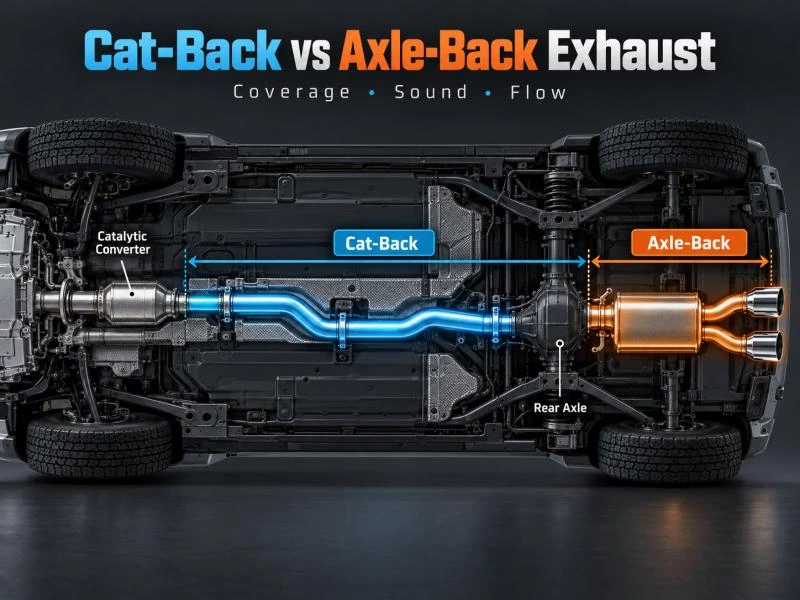
The simplest difference is location. An axle-back system normally replaces the exhaust components behind the rear axle, while a cat-back system replaces a much larger section extending from behind the catalytic converter to the exhaust outlet.
Because a cat-back replaces more exhaust tubing, it can change pipe diameter, routing, bends, resonator or muffler configuration, and outlet design. An axle-back usually leaves more of the original exhaust piping untouched and focuses primarily on the rear section.
Understanding this difference is important before choosing a replacement or custom system. Vehicle layout, engine type, exhaust diameter, chassis clearance, and intended use can all affect which configuration is more practical. For a broader explanation of how the complete system works, see our automotive exhaust system guide.
What Is an Axle-Back Exhaust?
An axle-back exhaust replaces the exhaust components located behind the vehicle's rear axle. Depending on the vehicle, this may include a short section of exhaust pipe, the rear muffler, and one or more exhaust tips.
A typical axle-back layout:
Existing Mid-Pipe → Rear Axle → Axle-Back Section → Muffler → Exhaust Tip
Because most of the original exhaust piping remains in place, an axle-back system usually changes less of the overall exhaust flow path than a cat-back system.
Its main advantages are typically:
- Smaller replacement area
- Lower component cost compared with a complete cat-back system
- Simpler installation on compatible vehicles
- Noticeable changes to rear exhaust sound
- Opportunity to change exhaust tip style or outlet appearance
What Parts Does an Axle-Back Replace?
The exact components depend on the vehicle design, but an axle-back system commonly replaces parts located near the rear of the vehicle.
| Component | Usually Replaced? |
|---|---|
| Front Exhaust Pipe | No |
| Catalytic Converter | No |
| Mid-Pipe | Usually No |
| Rear Pipe | Yes |
| Rear Muffler | Often |
| Exhaust Tip | Often |
For this reason, axle-back exhaust systems are often selected when the main goal is to change rear exhaust sound or appearance without replacing a large portion of the original piping.
What Is a Cat-Back Exhaust?
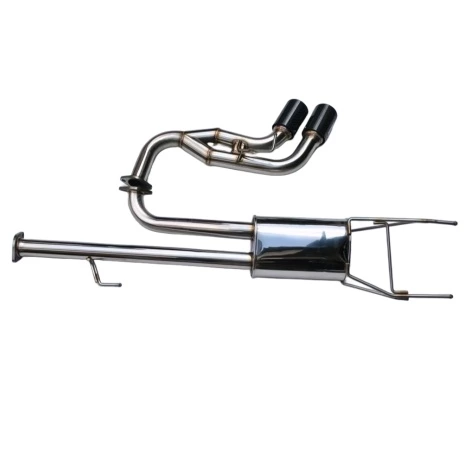
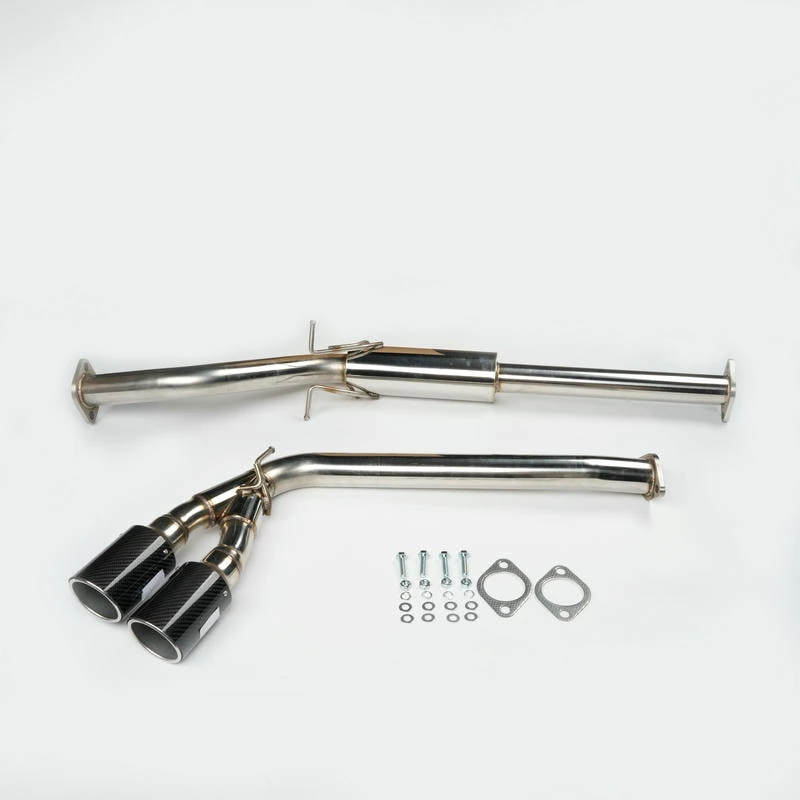
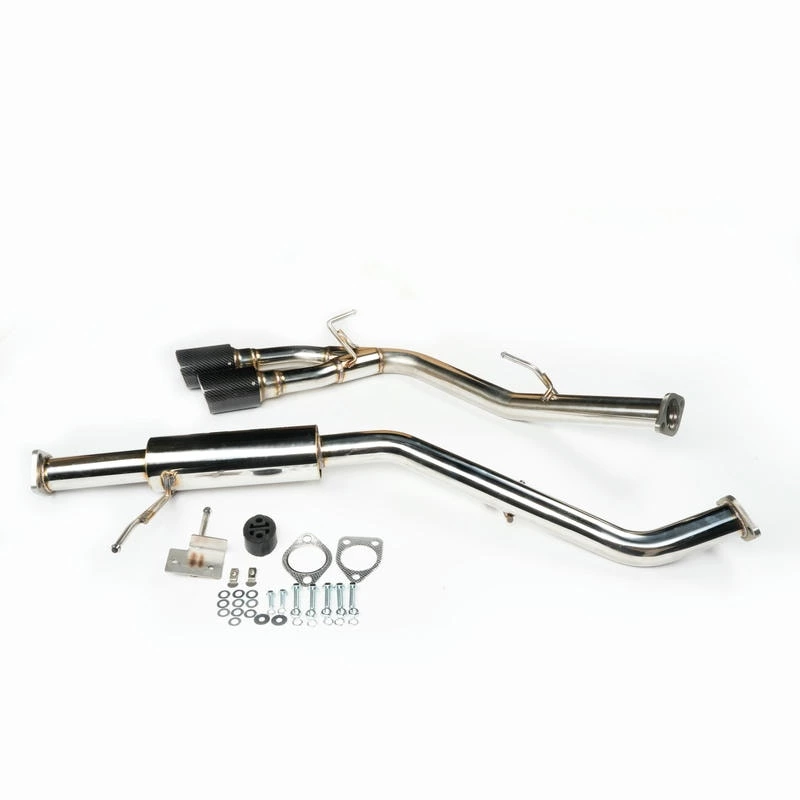
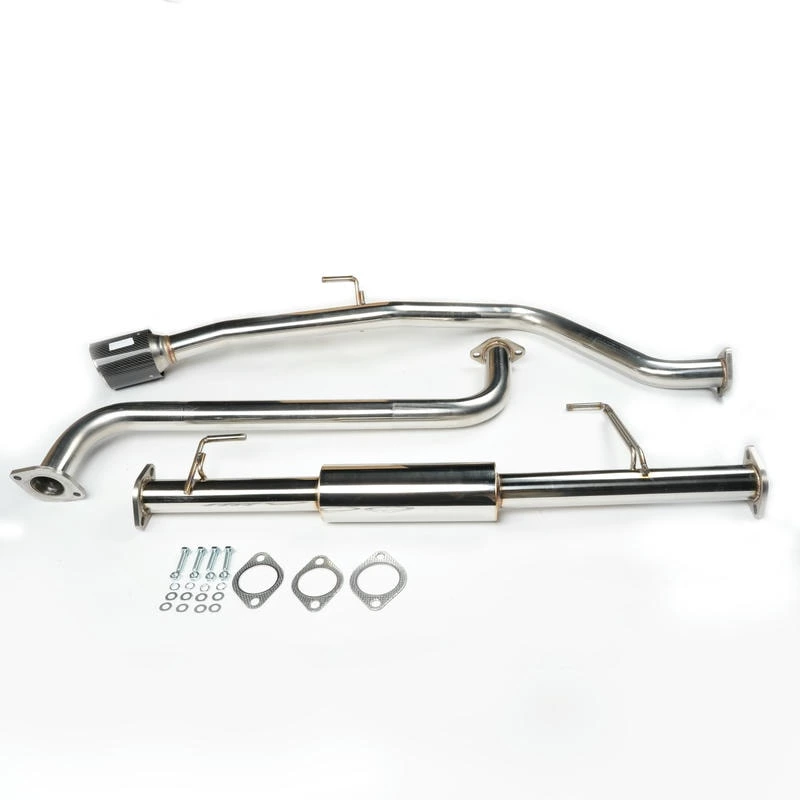
A cat-back exhaust replaces the exhaust system from behind the catalytic converter toward the rear of the vehicle. Compared with an axle-back, it normally includes substantially more exhaust pipe and may also replace the resonator, muffler, tailpipe, and exhaust tips.
A simplified cat-back layout:
Catalytic Converter → Cat-Back Pipe → Resonator / Muffler → Tailpipe → Exhaust Tip
Because more of the original exhaust system is replaced, a cat-back system provides greater control over pipe diameter, routing, bend design, material, and rear exhaust configuration.
This makes cat-back systems relevant not only to exhaust sound but also to the overall design of the downstream exhaust flow path.
What Parts Does a Cat-Back Replace?
| Component | Usually Replaced? |
|---|---|
| Exhaust Manifold | No |
| Downpipe | No |
| Catalytic Converter | No |
| Mid-Pipe | Usually Yes |
| Resonator | Depending on design |
| Muffler | Usually Yes |
| Tailpipe / Exhaust Tip | Usually Yes |
Since cat-back systems use more tubing, pipe diameter and bend design become more important. The largest possible pipe is not automatically the best solution; the correct diameter should match the engine, vehicle application, and overall exhaust configuration. Our exhaust pipe diameter guide explains this in more detail.
For OEM or vehicle-specific applications, cat-back exhaust sections can also be developed as part of a complete custom exhaust pipe system, with pipe routing, flanges, hangers, bends, and outlet positions matched to the vehicle.
Cat-Back vs Axle-Back Exhaust: Quick Comparison
| Feature | Cat-Back Exhaust | Axle-Back Exhaust |
|---|---|---|
| Replacement Area | From behind the catalytic converter to the exhaust outlet | Mainly behind the rear axle |
| Amount of Pipe Replaced | More | Less |
| Effect on Exhaust Flow | Greater potential influence | Usually more limited |
| Sound Change | Can change the overall exhaust character | Primarily changes rear exhaust sound |
| Installation Complexity | Higher | Usually lower |
| Cost | Generally higher | Generally lower |
| Weight Change Potential | Greater because more components are replaced | Smaller |
| Best Suited For | More complete exhaust-system changes | Sound and rear-section changes |
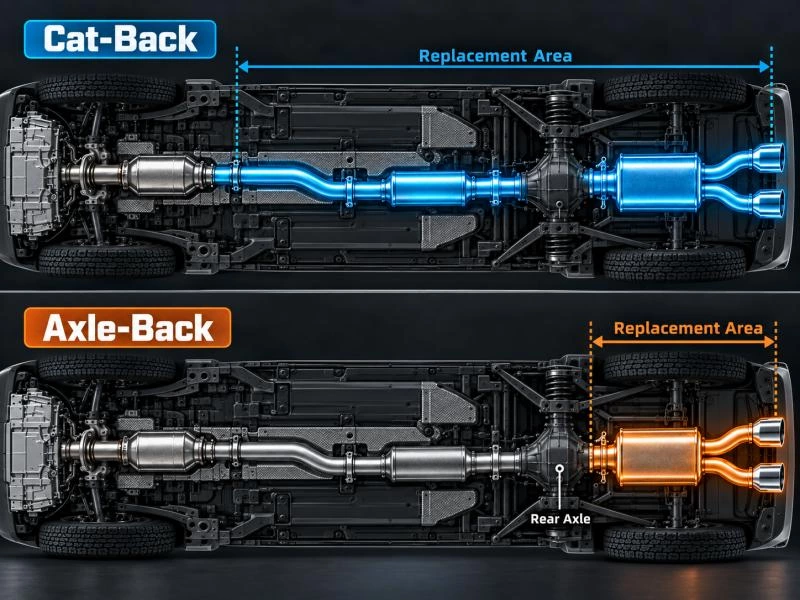
Quick answer: Choose an axle-back when the main priority is changing the rear exhaust section with minimal modification. Choose a cat-back when you want to replace more of the exhaust piping and have greater control over diameter, routing, sound, and downstream exhaust design.
Which Sounds Better: Cat-Back or Axle-Back?
Both cat-back and axle-back systems can change exhaust sound, but they do so in different ways because they replace different portions of the system.
An axle-back system mainly changes the rear section, so the sound difference usually comes from the muffler, tailpipe, and exhaust tip design. A cat-back system replaces more piping and may also change the resonator, muffler, pipe diameter, and routing, giving it greater influence over the overall exhaust tone.
| Sound Factor | Cat-Back | Axle-Back |
|---|---|---|
| Overall Volume Change | Moderate to significant depending on design | Usually moderate |
| Exhaust Tone | Can change across a wider RPM range | Mainly influenced by rear muffler and outlet |
| Resonator Influence | May change if the resonator is included | Usually unchanged |
| Pipe Diameter Influence | Greater | Limited |
Sound also depends heavily on the engine, turbocharger, muffler design, resonator, pipe length, diameter, and outlet configuration. A cat-back system is not automatically louder than every axle-back system, and a louder system is not necessarily the better choice for every vehicle.
Which Is Better for Daily Driving?
For daily-driven vehicles, an axle-back can be a practical choice when the main goal is a different exhaust note without changing a large part of the factory system.
A cat-back may be more suitable when the owner wants a more complete change in exhaust character, but comfort should still be considered. Excessive low-frequency noise or exhaust drone can become tiring during highway driving.
Which Improves Exhaust Flow More?
A cat-back system generally has greater potential to influence exhaust flow because it replaces a longer section of pipe behind the catalytic converter.
This allows changes to:
- Pipe diameter
- Bend geometry
- Mid-pipe routing
- Resonator design
- Muffler restriction
- Outlet configuration
An axle-back replaces much less tubing, so most of the original mid-pipe and upstream exhaust geometry remain unchanged. Its effect on total system restriction is therefore usually more limited.
Key point: A cat-back offers more opportunity to change exhaust flow, but actual performance depends on the original system, engine output, pipe size, bends, and downstream components.
Does a Cat-Back Exhaust Increase Horsepower?
A cat-back exhaust can reduce restriction in some vehicles, especially when the original rear exhaust uses narrow tubing, restrictive bends, or highly restrictive mufflers.
However, there is no guaranteed horsepower increase. Some vehicles may show only a small change because the main restriction remains farther upstream in the catalytic converter, downpipe, manifold, or turbocharger.
This is why exhaust upgrades should be evaluated as part of the complete system rather than by pipe size alone. If you want to understand how pipe diameter affects flow and performance, see our exhaust pipe diameter guide.
Does an Axle-Back Increase Performance?
An axle-back system may reduce some restriction in the rear section, but because it leaves most of the factory exhaust piping unchanged, its performance effect is generally smaller than a cat-back system.
For most axle-back applications, the main reasons for choosing the system are sound, appearance, and simpler installation rather than significant changes in engine output.
Cat-Back vs Axle-Back Exhaust Cost
Axle-back systems are generally less expensive because they replace fewer components and use less exhaust tubing. Installation also tends to involve fewer connections and mounting points.
Cat-back systems usually cost more because they include a larger portion of the exhaust system and may require additional pipes, bends, hangers, resonators, mufflers, and outlets.
| Cost Factor | Cat-Back | Axle-Back |
|---|---|---|
| Amount of Tubing | More | Less |
| Number of Components | More | Fewer |
| Manufacturing Complexity | Higher | Lower |
| Installation Time | Usually longer | Usually shorter |
| Typical Price Level | Higher | Lower |
What Affects the Final Exhaust System Price?
The actual cost of either system depends on more than whether it is cat-back or axle-back. Important factors include:
- Vehicle make and model
- Single or dual outlet design
- Pipe diameter
- Material such as 304 or 409 stainless steel
- Number and complexity of bends
- Muffler and resonator design
- Flanges, hangers, and connection hardware
- Custom or OEM production requirements
If you are comparing replacement costs, our exhaust pipe replacement cost guide explains how materials, fitment, manufacturing complexity, and labor can affect total pricing.
Which Is Easier to Install: Cat-Back or Axle-Back?
An axle-back exhaust is generally easier to install because it replaces a smaller section of the original exhaust system. Fewer pipes, hangers, and connection points usually mean less disassembly and less time spent aligning the new components.
A cat-back system replaces a longer section behind the catalytic converter, so installation may involve additional mid-pipes, resonators, mufflers, hangers, and joints. Accurate alignment becomes more important because a small positioning error near the front of the system can affect the exhaust outlet position farther toward the rear.
| Installation Factor | Cat-Back | Axle-Back |
|---|---|---|
| Number of Components | More | Fewer |
| Pipe Alignment | More critical across a longer section | Usually limited to the rear section |
| Hanger Positions | More mounting points may be involved | Usually fewer |
| Installation Time | Usually longer | Usually shorter |
| Modification Risk | Higher if fitment is incorrect | Generally lower on vehicle-specific systems |
Vehicle-specific bolt-on systems can simplify both types of installation because flange positions, pipe bends, hangers, and outlet locations are designed around the original vehicle layout.
Fitment matters more than system type. A correctly designed cat-back can install more easily than a poorly matched axle-back that requires cutting, welding, or hanger modification.
Does Vehicle Layout Affect Cat-Back vs Axle-Back Choice?
Yes. Vehicle layout is one of the most important factors when deciding whether an axle-back or cat-back exhaust is practical. The terms describe where the replacement section begins, but not every vehicle has the same exhaust routing around the rear axle.
Sedans, coupes, SUVs, and pickup trucks can have very different chassis layouts. Fuel tanks, spare wheels, rear suspension components, axles, heat shields, and body structure all affect how the exhaust pipe can be routed.
Not Every Vehicle Has a Practical Axle-Back Layout
Axle-back systems are common on vehicles where the rear muffler and tailpipe form a clearly separated section behind the rear axle. In these applications, the rear section can often be replaced without changing much of the upstream exhaust.
However, some pickup trucks and SUVs use longer rear pipes, side-exit layouts, different muffler positions, or exhaust routing that crosses around the axle and chassis. In these vehicles, describing the replacement only as “axle-back” may not accurately represent the actual pipe section being changed.
The exhaust configuration should therefore be identified from the actual vehicle rather than choosing a system only by category name.
Cat-Back vs Axle-Back for Trucks and SUVs
For trucks and SUVs, exhaust-system selection often depends more heavily on chassis packaging and vehicle use than it does on performance-car terminology.
Important factors include:
- Wheelbase and chassis length
- Rear axle and suspension clearance
- Spare tire position
- Fuel tank location
- DPF or catalytic converter position
- Single or dual outlet routing
- Rear bumper and side-exit clearance
- Off-road suspension movement
For example, pickup applications such as Toyota Hilux and Ford Ranger may use long vehicle-specific exhaust sections with different outlet positions and wheelbase requirements. In these cases, a more complete exhaust assembly may be more practical than trying to apply a generic axle-back layout.
AOSU supplies vehicle-specific exhaust solutions for platforms including Toyota and Ford, with pipe routing and connection design developed around the actual vehicle application.
Why Chassis Clearance Matters
An exhaust pipe must maintain sufficient clearance from the axle, suspension, body panels, spare wheel, and other nearby components. This becomes especially important on trucks and SUVs that may experience greater suspension travel or operate on uneven roads.
Incorrect routing can lead to:
- Pipe contact with the chassis
- Vibration or rattling
- Insufficient axle clearance
- Incorrect exhaust outlet position
- Stress on hangers and joints
For replacement or custom systems, accurate pipe dimensions and routing are therefore essential. Our exhaust pipe measurement guide explains how diameter, length, bends, and connection points should be checked before production or replacement.
Single vs Dual Outlet: Does It Change the Choice?
Both cat-back and axle-back exhaust systems can use either a single or dual outlet. The outlet configuration is separate from the point where the replacement system begins.
A cat-back system, for example, may start behind the catalytic converter and finish with either one exhaust outlet or two. An axle-back can also use a single or dual rear-exit design depending on vehicle packaging.
| Outlet Design | Main Considerations |
|---|---|
| Single Outlet | Simpler routing, fewer rear pipe sections, compact packaging |
| Dual Outlet | Additional routing, more hangers, different bumper and chassis clearance |
The better option depends on the vehicle design, available space, desired appearance, and exhaust layout. A dual outlet does not automatically mean the vehicle has a true dual exhaust system from the engine; in many cases, one pipe simply divides into two rear outlets.
For OEM and custom projects, AOSU can develop vehicle-specific exhaust pipe systems with single or dual outlet configurations according to drawings, samples, chassis layout, and project requirements.
How to Choose Between Cat-Back and Axle-Back Exhaust
Choosing between a cat-back and axle-back exhaust depends on what you want to change, how much of the original exhaust system you want to replace, and how the vehicle is designed.
An axle-back is usually more suitable when the main goal is to change rear exhaust sound or appearance with a smaller replacement area. A cat-back is generally more appropriate when you want greater control over pipe diameter, routing, resonator or muffler design, and the overall downstream exhaust layout.
| Your Priority | Better Starting Point |
|---|---|
| Lower cost | Axle-Back |
| Simpler installation | Axle-Back |
| Change rear exhaust sound | Axle-Back |
| Replace more exhaust piping | Cat-Back |
| Change pipe diameter or routing | Cat-Back |
| Greater influence on exhaust flow | Cat-Back |
| Replace aging mid and rear exhaust sections | Cat-Back |
Choose an Axle-Back If...
- You mainly want a different exhaust sound
- You want to keep most of the original exhaust system
- You prefer a lower-cost modification
- You want a simpler rear-section replacement
- Your vehicle has a clearly separated axle-back layout
Choose a Cat-Back If...
- You want to replace a larger portion of the exhaust system
- You want greater control over pipe diameter and bends
- You want to change the resonator, muffler, and rear pipe together
- The original mid or rear exhaust sections are damaged or restrictive
- You need a vehicle-specific single or dual outlet configuration
There is no universally better option. The correct choice depends on vehicle layout, exhaust condition, intended sound, flow requirements, installation complexity, and budget.
OEM and Custom Exhaust System Considerations
For OEM buyers, distributors, and custom vehicle projects, choosing between cat-back and axle-back is only the first step. The exhaust system still needs to match the actual vehicle dimensions and installation requirements.
Important specifications include:
- Vehicle make, model, year, and engine
- Catalytic converter or DPF position
- Exhaust pipe diameter
- Wheelbase and chassis layout
- Bend locations and routing
- Flange and clamp connections
- Hanger positions
- Muffler and resonator configuration
- Single or dual outlet design
- Material and wall thickness
Why Vehicle-Specific Exhaust Design Matters
Universal exhaust components may require cutting, welding, additional adapters, or hanger modification. A vehicle-specific system is developed around the original chassis and exhaust layout, helping reduce installation adjustments.
For custom projects, drawings or physical samples can be used to define pipe geometry, mounting points, connection positions, and outlet routing.
If the original exhaust pipe needs to be measured before development, see our guide to measuring exhaust pipe diameter, length, bends, and fitment.
Material Selection for Cat-Back and Axle-Back Systems
Material also affects durability, corrosion resistance, appearance, and cost. Stainless steel is commonly used for automotive exhaust systems because it performs well under repeated heat cycles and exposure to moisture and road contaminants.
304 stainless steel generally provides higher corrosion resistance, while 409 stainless steel is widely used in automotive exhaust applications because of its balance of durability and cost.
For more information, see our stainless steel exhaust pipe guide.
Custom Cat-Back and Axle-Back Exhaust Solutions
AOSU supports OEM and custom exhaust pipe systems for different automotive applications, including vehicle-specific tube bending, welding, flange positioning, hanger installation, and single or dual outlet configurations.
For projects requiring a complete exhaust section rather than a standard universal part, customers can provide drawings, physical samples, vehicle specifications, materials, and expected quantities for evaluation.
AOSU currently supports exhaust applications for brands including Toyota, Ford, Isuzu, Mitsubishi, Nissan, and Honda.
FAQ About Cat-Back vs Axle-Back Exhaust
What is the main difference between a cat-back and axle-back exhaust?
The main difference is how much of the exhaust system is replaced. A cat-back system usually replaces the section from behind the catalytic converter to the exhaust outlet, while an axle-back replaces only the rear section behind the rear axle.
Is a cat-back exhaust louder than an axle-back?
Not necessarily. A cat-back can have a greater influence on overall exhaust tone because it replaces more piping and may change the resonator and muffler, but final sound still depends on the engine, pipe diameter, muffler design, resonator, and outlet configuration.
Which is better for performance: cat-back or axle-back?
A cat-back generally has greater potential to affect exhaust flow because it replaces a longer section of pipe and allows changes to diameter, bends, routing, and muffler restriction. An axle-back usually has less influence on total system flow because most of the original exhaust remains in place.
However, neither system guarantees a specific horsepower increase. Actual results depend on the vehicle and the complete exhaust configuration.
Which is cheaper: cat-back or axle-back?
Axle-back systems are usually less expensive because they require less tubing, fewer components, and less installation work. Cat-back systems normally cost more because they replace a larger portion of the exhaust system.
Is an axle-back easier to install?
In most cases, yes. An axle-back involves fewer pipes and connection points, so installation is generally simpler. A vehicle-specific bolt-on design can further reduce the need for cutting, welding, or hanger modification.
Does a cat-back exhaust affect emissions?
A conventional cat-back system begins behind the catalytic converter, so it normally does not remove the primary emissions-control component. However, exhaust layouts vary by vehicle, so the exact location of catalysts, DPFs, and sensors should be confirmed before modification.
Can trucks and SUVs use axle-back exhaust systems?
Yes, but not every truck or SUV has a practical axle-back layout. Pickup trucks and SUVs may use longer rear pipes, side exits, different muffler positions, or chassis routing that makes a cat-back, DPF-back, or complete exhaust section more suitable.
For vehicle-specific applications, AOSU supports exhaust systems for platforms including Toyota, Ford, Isuzu, and other automotive brands.
Can I replace only the axle-back section first and upgrade later?
On compatible vehicles, yes. Some owners begin with the rear section and later replace additional exhaust piping. Before doing so, check pipe diameter, connection type, flange position, and overall compatibility between the existing and new sections.
If two exhaust sections need to be connected, our guide on how to join two exhaust pipes explains common clamp, sleeve, flange, and welding methods.
How do I know which exhaust system fits my vehicle?
Start with the vehicle make, model, year, engine, wheelbase, catalyst or DPF position, pipe diameter, hanger locations, and outlet configuration. Vehicle-specific drawings or a physical sample can provide additional information for custom production.
For replacement measurements, see our exhaust pipe measurement guide.
Conclusion
The difference between a cat-back and axle-back exhaust comes down mainly to the section of the exhaust system being replaced.
An axle-back exhaust focuses on the rear section behind the axle, making it a practical choice for drivers who mainly want to change exhaust sound, outlet appearance, or the rear muffler without replacing a large amount of piping.
A cat-back exhaust replaces a larger section from behind the catalytic converter toward the rear of the vehicle. Because it includes more exhaust pipe, it provides greater control over pipe diameter, routing, resonator and muffler design, and overall downstream exhaust flow.
Neither option is automatically better for every vehicle. The correct choice depends on the chassis layout, engine, exhaust condition, desired sound, flow requirements, budget, and installation goals. Trucks and SUVs may also require different system layouts than sedans or coupes because of wheelbase, axle clearance, suspension, spare tire position, and catalyst or DPF location.
For OEM and custom projects, accurate fitment information is especially important. AOSU provides OEM and custom exhaust pipe solutions for vehicle-specific applications, including pipe bending, welding, flange positioning, hanger installation, and single or dual outlet configurations.
If you need a custom cat-back, rear exhaust section, or complete vehicle-specific exhaust system, contact AOSU with your vehicle details, drawings, samples, material requirements, and expected order quantity for further evaluation.